

Main image: illustrative brand review concept, not a client project or ADAMS team photograph
Before commissioning a new logo, decide what your business actually needs to change. If your positioning still fits but your website and social posts look unrelated, the first job may be consistent application. If the identity is relevant but difficult to use digitally, a focused refresh may be enough. If the business has changed who it serves or what it stands for, investigate the strategy before redesigning its expression
Choosing between a brand refresh and a rebrand starts with that diagnosis. These labels vary between providers, so use them as working descriptions and agree the actual scope in writing. The useful question is which problem the work must solve, what should be preserved and how the new direction will be used
Identify whether the problem is strategy, identity or application
Bring examples from your current website, social profiles and campaign assets into the same review. Look for specific mismatches rather than asking whether everything feels modern enough. A service description aimed at the wrong buyer is a different problem from unreadable lettering in a profile image
Start with the business: are the audience, offer and reasons to choose you still accurate? Then examine the identity: do its visual and verbal elements express those decisions clearly? Finally, inspect the applications: are people using the approved elements consistently across the places customers encounter you?
Brand identity extends beyond a logo. Interbrand describes identity through visual and verbal systems, including messaging and tone of voice. For your brief, separate the parts that need work instead of assuming that a logo replacement addresses them all
- Application problem: the agreed identity remains useful, but teams use conflicting colours, old files or unrelated layouts
- Expression problem: the business direction remains relevant, but typography, layout or logo variants are difficult to use in current digital placements
- Strategic mismatch: the audience, offer or positioning has changed enough that the existing story deserves investigation
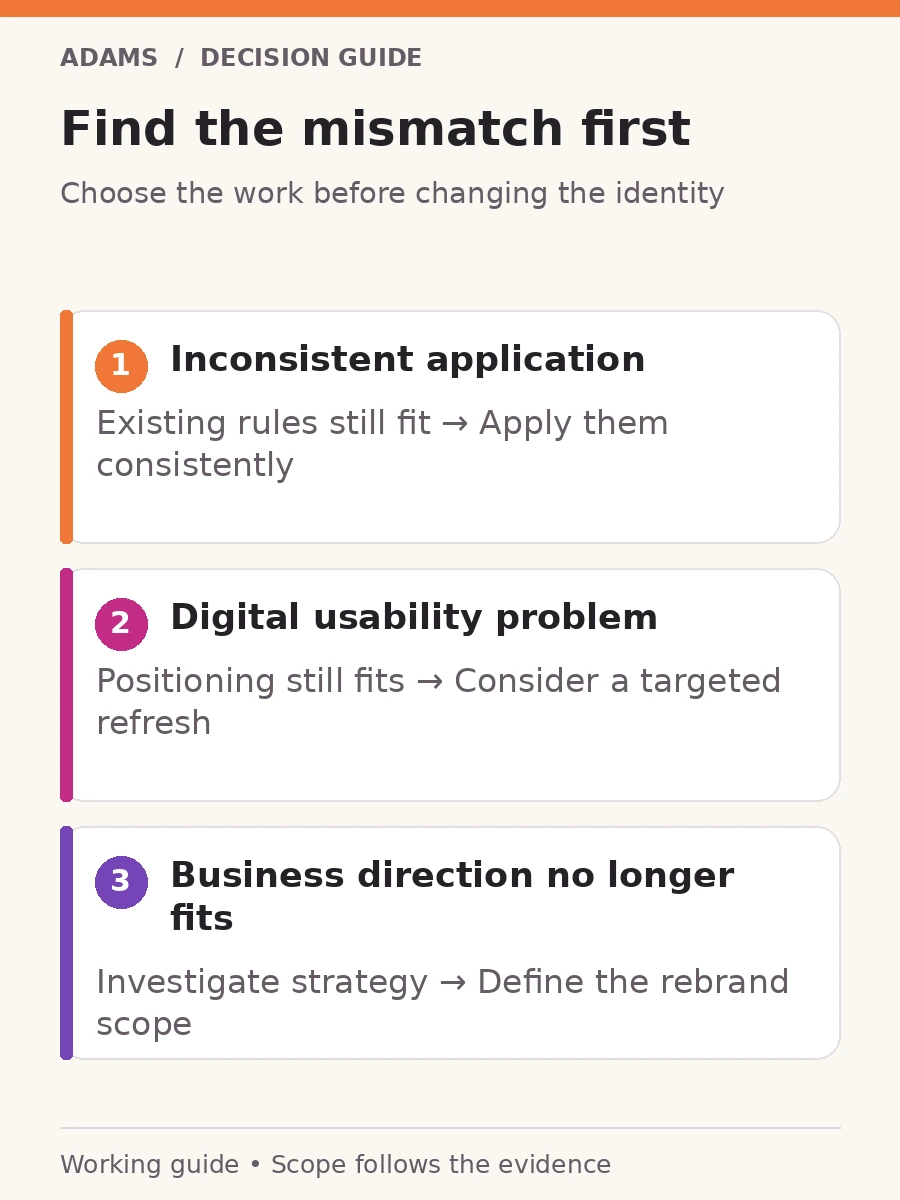
These problems can overlap. A strategic review might identify a targeted visual change rather than a complete replacement. Weak campaign results alone do not establish that your identity is failing; the offer, audience, destination and measurement may need investigation too
Use a refresh when the direction still fits
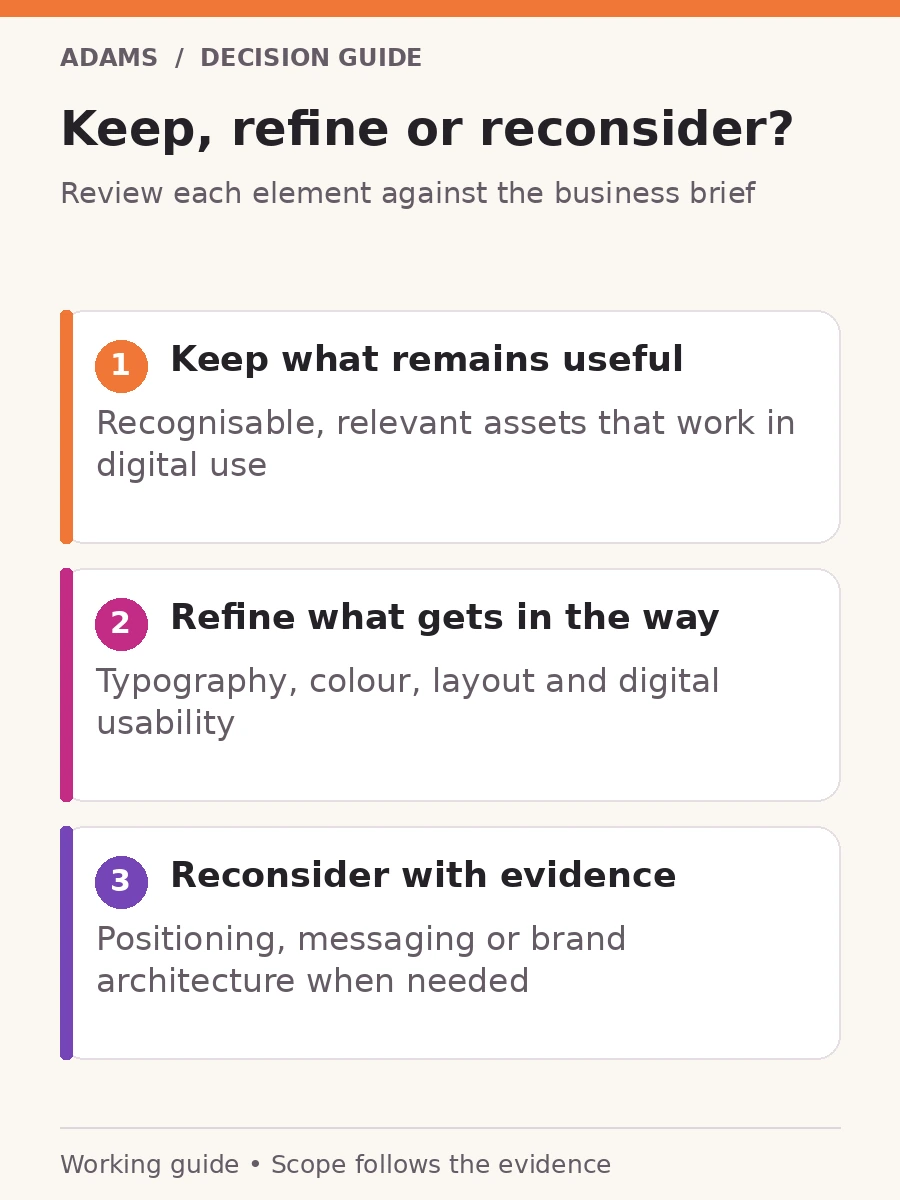
For this decision, a refresh means improving how an existing identity works while retaining the elements that remain relevant and recognisable. It might involve clearer typography, a more practical colour system, simpler digital layouts or approved variants for small spaces. It does not automatically require a new logo
Consider an illustrative professional-services business whose offer and audience are unchanged. Its full wordmark becomes difficult to read in a small social avatar, while its website and posts use inconsistent spacing. Reviewing small-format variants and application rules is a more precise brief than replacing every identity element
Before changing an established feature, ask what evidence supports keeping or replacing it. Useful inputs include recurring customer misunderstandings, observed readability problems and the team’s actual difficulties using the assets. The owner’s personal preference can inform a direction, but it should not be treated as customer research
Write down what must survive the work: perhaps a distinctive symbol, a name customers already use or a relevant colour association. Treat those as questions to validate, rather than assuming that everything familiar has equal value
Investigate rebranding when the business meaning has changed
A deeper review becomes useful when the identity communicates an offer you no longer provide, addresses a buyer you no longer prioritise or makes the relationship between services difficult to understand. A business expanding from a narrow product into a different service model may need to revisit its positioning before deciding what its identity should express
Here, rebranding means reconsidering the brand’s direction and the changes required to express it. The eventual work may include positioning, messaging, identity or relationships between offers. Neither a new name nor a new domain should be assumed necessary
Pentagram’s description of brand strategy connects research and strategic thinking to the way a brand appears in the real world. Apply that principle by asking what a proposed strategic decision changes in the words, design and experience customers actually encounter
Agree the questions before asking for design routes. Which audience needs a clearer explanation? Which parts of the offer are being misunderstood? What evidence would change your view? If the commercial direction is unresolved, making the design more polished will leave that decision unresolved too
Test the proposed identity where customers will use it
Judge a direction in practical digital contexts rather than accepting a single attractive presentation. Ask to see the relevant website header on a small screen, a social profile image, a content layout and an advertising placement. These are checks of the system’s usefulness, not evidence that a campaign has performed
Read the actual words at the intended size. Check whether the logo remains identifiable, headings are easy to scan and controls still look usable. Confirm that the required language versions can work within the design. If bilingual applications are needed, include them in the brief rather than assuming they are covered
Consistency matters within an experience as well as between assets. Nielsen Norman Group’s consistency guidance explains how familiar patterns help people understand interfaces. A distinctive identity can still preserve recognisable links, buttons and navigation
Use feedback to identify the problem observed and the change requested. “The service name is difficult to read in the mobile header” gives the designer something to resolve. “Make it more premium” needs further discussion before it becomes an actionable acceptance condition
Define the scope and rollout before approving production
A chosen visual direction is only part of implementation. List the digital touchpoints that need updating, who controls them and which files or templates each owner needs. Separate designing the identity from producing every application and changing live channels
Agree the deliverables, revision stages, approver, usage guidance and handover formats. Confirm whether editable files are included and how any font or other third-party licences will be handled. These are scope questions for the proposal, not an assumption that every branding package includes everything
- Inventory: record current website, profile, content and advertising uses, including outdated variants
- Test: review the proposed direction in the actual formats and language requirements
- Approve: confirm the selected assets, practical rules, responsibilities and acceptance checks
- Roll out: update priority touchpoints, check the published applications and retire superseded working files from routine use
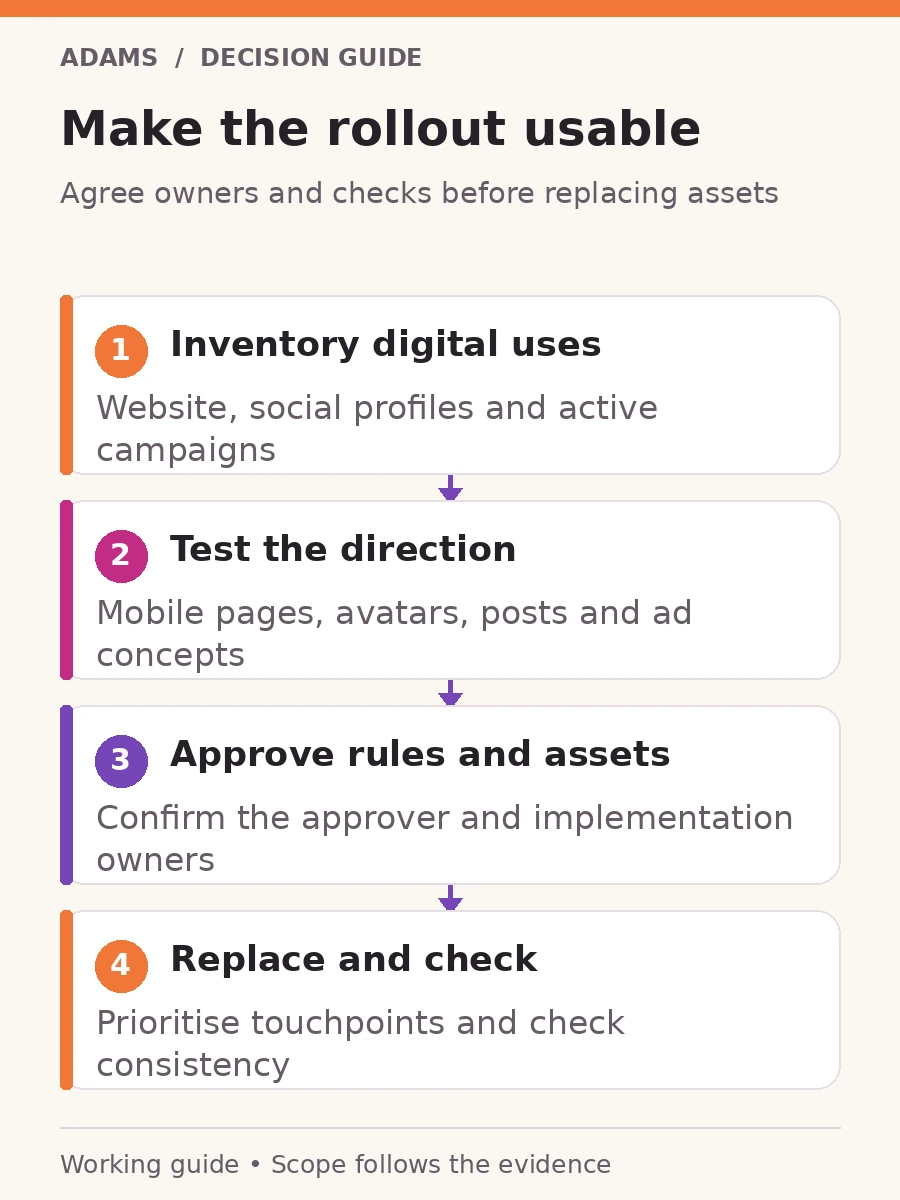
Retain an organised archive and identify the current approved files so the team does not reintroduce older variants. Review live applications after launch: the right export can still be cropped incorrectly, placed on an unsuitable background or paired with old wording
If the website itself needs structural changes alongside the identity, prepare a separate website redesign brief. This keeps content, functionality and launch responsibilities visible rather than hiding a website project inside a visual update
Choose the smallest scope that addresses the evidence
Prepare a short brief with the business change, the mismatch you have observed, examples of current applications, elements worth retaining and the digital uses that must work. Add the decisions still open and name the person who can approve them
If the direction is sound, start by fixing its application. If the expression is the obstacle, explore a focused refresh. If the business meaning has changed, investigate the strategy and then define the identity work. The scope should follow that reasoning rather than a preference for the biggest redesign
Explore ADAMS Creative Design to discuss the digital applications you need, with any identity project scoped separately. If audience and positioning decisions still need resolving, start with marketing strategy so the design has a clear direction to express