
An English campaign invites someone to discuss a service requirement. Its Arabic version says they can book the service immediately. The pictures may belong to the same campaign, but the two messages have made different promises
Preparing Arabic and English campaigns means checking what the reader understands and what happens after the click. Keep the approved offer and its limits consistent, while giving each language natural wording, a useful destination and a response the business can actually provide
This guide is an ADAMS review method for owners and marketing teams preparing a bilingual campaign. The maintenance-service example is fictional and illustrates editorial decisions, not a real client, an available service or measured campaign results
The main image is a conceptual scene of two routes around one shared idea, not a real agency meeting, client project or campaign result
Agree the offer before writing either version
Start with a short shared brief: who the service is for, what is being offered, the conditions that matter and the next action the business is ready to handle. Include the facts that must remain true in both languages, such as the service boundary, coverage, availability conditions and what an enquiry does or does not confirm
If those facts are uncertain, resolve them with the responsible person before polishing the headline. A translator or copywriter should not have to invent whether a visit is included, whether an assessment is needed or when a request becomes a confirmed booking
Keep the commercial facts separate from the expression of the message. The same offer can have different sentence structures, line breaks and supporting explanations. It should not gain a stronger promise in one language merely because the shorter phrase sounds more attractive
Write around the reader’s task, then compare the meaning
Ask what the reader needs to decide before responding. Do they need to assess suitability, understand the process, check an important limitation or prepare information for a quotation? Choose wording that helps them take that step in the language they are reading
Use the terms the intended audience actually uses, informed by approved customer questions, current search results and professional usage in the relevant market. Do not assume that every Arabic reader wants informal language or that every English reader wants the same level of technical detail. Language alone does not establish a person’s nationality, role or buying preference
Give the Arabic writer the shared brief and supporting facts, rather than treating the English headline as the entire instruction. A useful Arabic version may start with the customer’s situation where the English version starts with an action. Compare what each version promises, who it addresses and what it asks the reader to do, rather than checking whether every word has a matching word
If an approver cannot read both languages, add a plain meaning summary explaining the offer, conditions and requested action. That summary helps the business review a claim; it does not replace an independent language review of the actual words
Worked example: an enquiry is not a confirmed visit
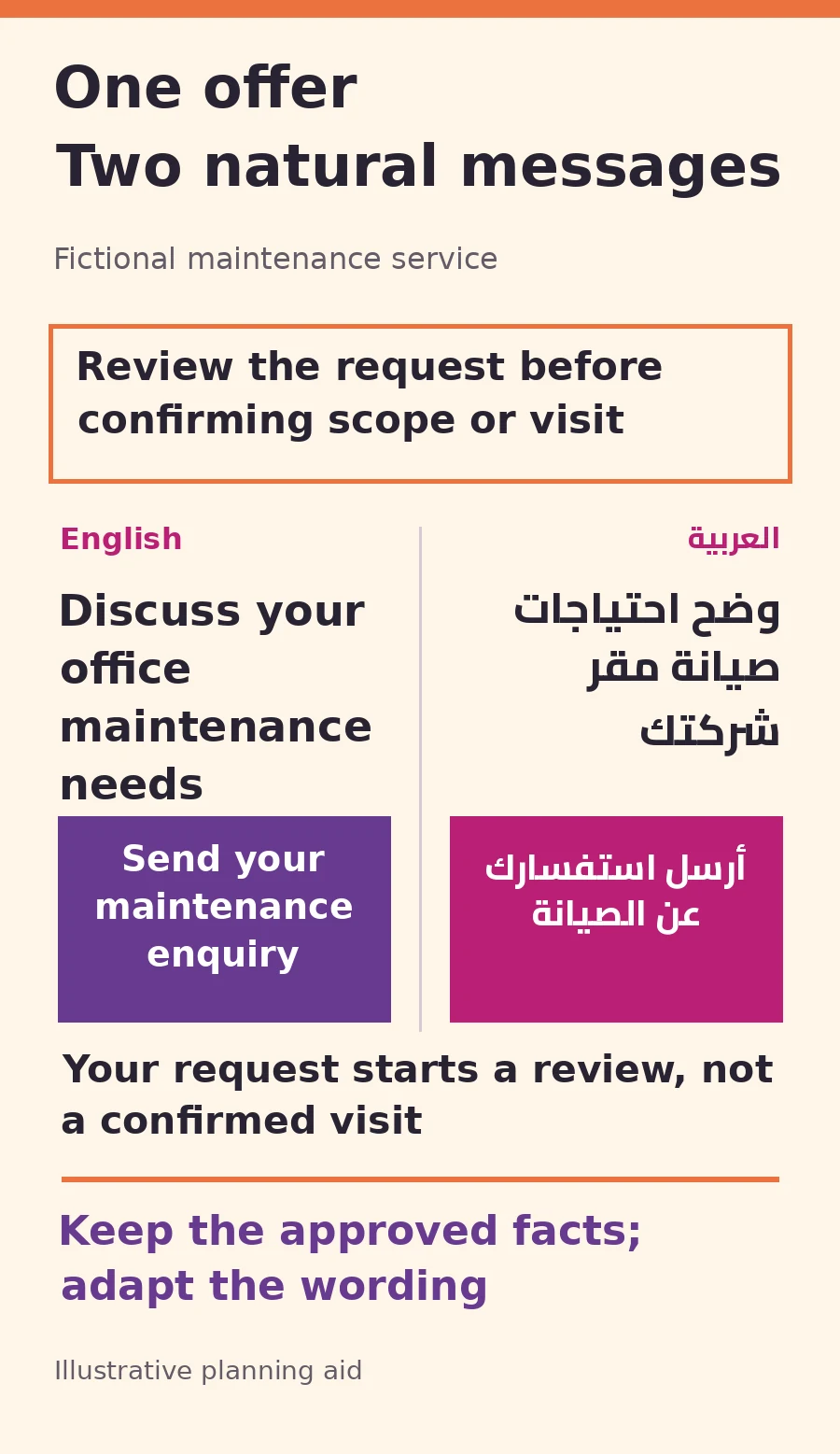
Fictional campaign example: a provider of maintenance services for company premises wants prospective customers to explain their needs. Its team reviews the request before agreeing the scope or arranging a visit. No price, response time, availability or technical capability is assumed
A pair of messages that keeps the same boundary
The English message could say “Discuss your office maintenance needs”. The Arabic message could say «وضح احتياجات صيانة مقر شركتك». The wording differs, but both invite an initial conversation about the same service need
Each destination then explains that the customer sends a request first and that the team confirms the scope and visit arrangements after review. A suitable action could be “Send your maintenance enquiry”, with «أرسل استفسارك عن الصيانة» in Arabic. The adjacent explanation makes clear that sending the request does not book a visit
A more forceful phrase can change the offer
“Book an engineer now” would be a different instruction. Using that claim in either language would need business approval and an actual process supporting it. The correction is not simply to make the other language equally forceful; it is to restore the action the business can confirm
This example is about keeping the meaning and operational next step equivalent. It is not a recommendation that every service campaign use an enquiry form or the same wording
Connect each message to the page and response it needs
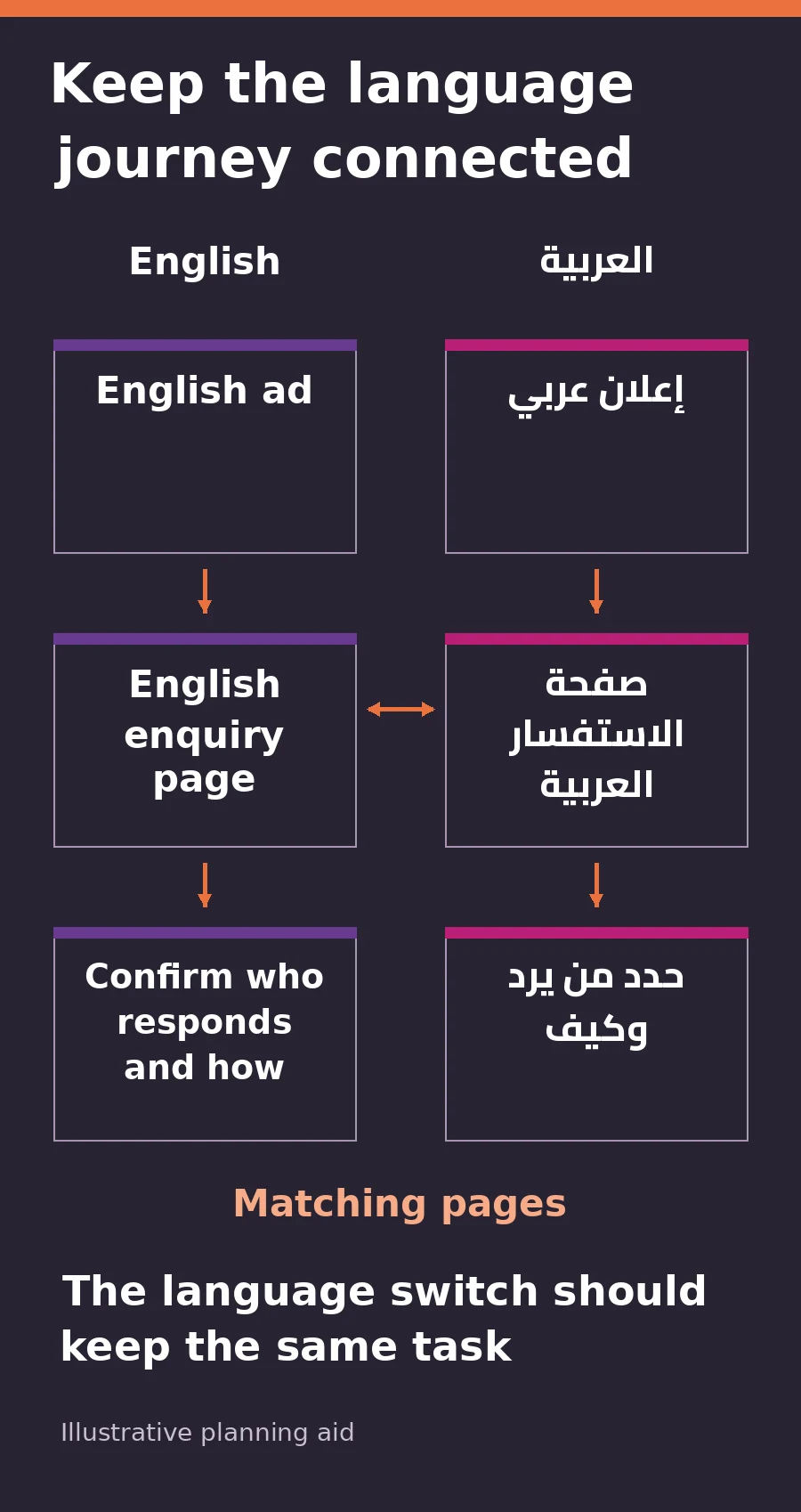
Record the actual destination for each approved message. An Arabic ad should lead to the relevant Arabic explanation, and an English ad to its relevant English explanation. A translated headline followed by an untranslated page, an unrelated homepage or missing conditions is an incomplete route
Google’s ad and landing-page guidance recommends a close match between the ad, the page and the intended action. Apply that check to each language version: can the reader find the offer they expected and understand the next step?
If you have not yet chosen the right destination, our homepage and dedicated landing-page guide covers that decision. A new page is not automatically necessary when a suitable existing service page can provide the complete answer
Keep essential facts and conditions equivalent, including supporting instructions and the message shown after submission. Provide a visible way to change language that opens the corresponding page. W3C’s internationalisation guidance recommends visible links to localised content using the target language’s own name
Then check what happens beyond the page. The person receiving the request needs to recognise the offer, understand the information supplied and know who can reply in the required language. If that response is not available, resolve the delivery arrangement or state the limitation clearly before launch
Review the actual Arabic layout, not a mirrored preview
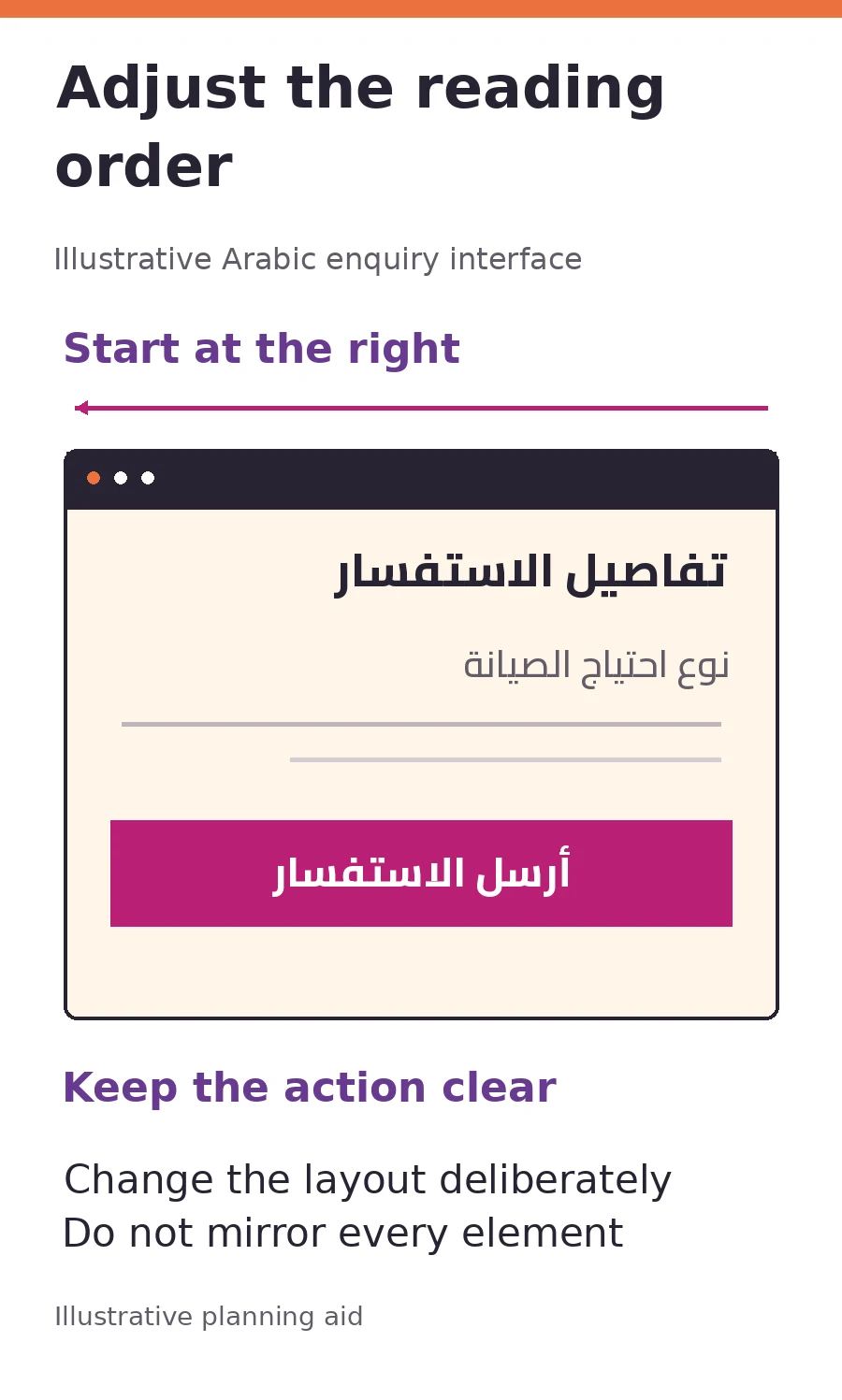
Read the exported creative and the working page at their intended size. Arabic may need different line breaks, spacing and text placement from English. Do not shrink it until it fits the original English box or mirror every logo, image and symbol without checking what the change means
For web pages, W3C’s direction guidance explains the need for the appropriate base direction, including right-to-left Arabic pages. Review embedded English terms, numbers, punctuation and form inputs separately; visual right alignment alone does not establish correct mixed-language behaviour
Check the heading, supporting information, action label and any conditions together on a phone. Make sure connected Arabic letters remain intact and interface controls do not cover important wording. Keep the essential website explanation as readable text, with appropriate image alternatives
The campaign design-system guide explains how the visual family can adapt across placements. Here, the additional check is that a layout change has preserved the language’s meaning and the action it describes
Separate platform delivery from language readiness
Do not use a language setting as proof that the message, page or response has been prepared. Review the current rules for the actual platform, campaign type and network, alongside the available features in the account
As checked on 14 November 2026, Google’s language-targeting documentation describes changes starting in September 2026 for Search campaigns and the Search part of Performance Max, while other Performance Max channels retain language settings. A single old setup instruction therefore should not be applied to every campaign
This is not an account-configuration walkthrough. Whatever delivery or localisation tools are used, review the wording actually served and the destination actually opened. Automated assistance does not remove the need to confirm claims, language quality and the business’s ability to handle the response
Approve complete language routes and learn from their outcomes
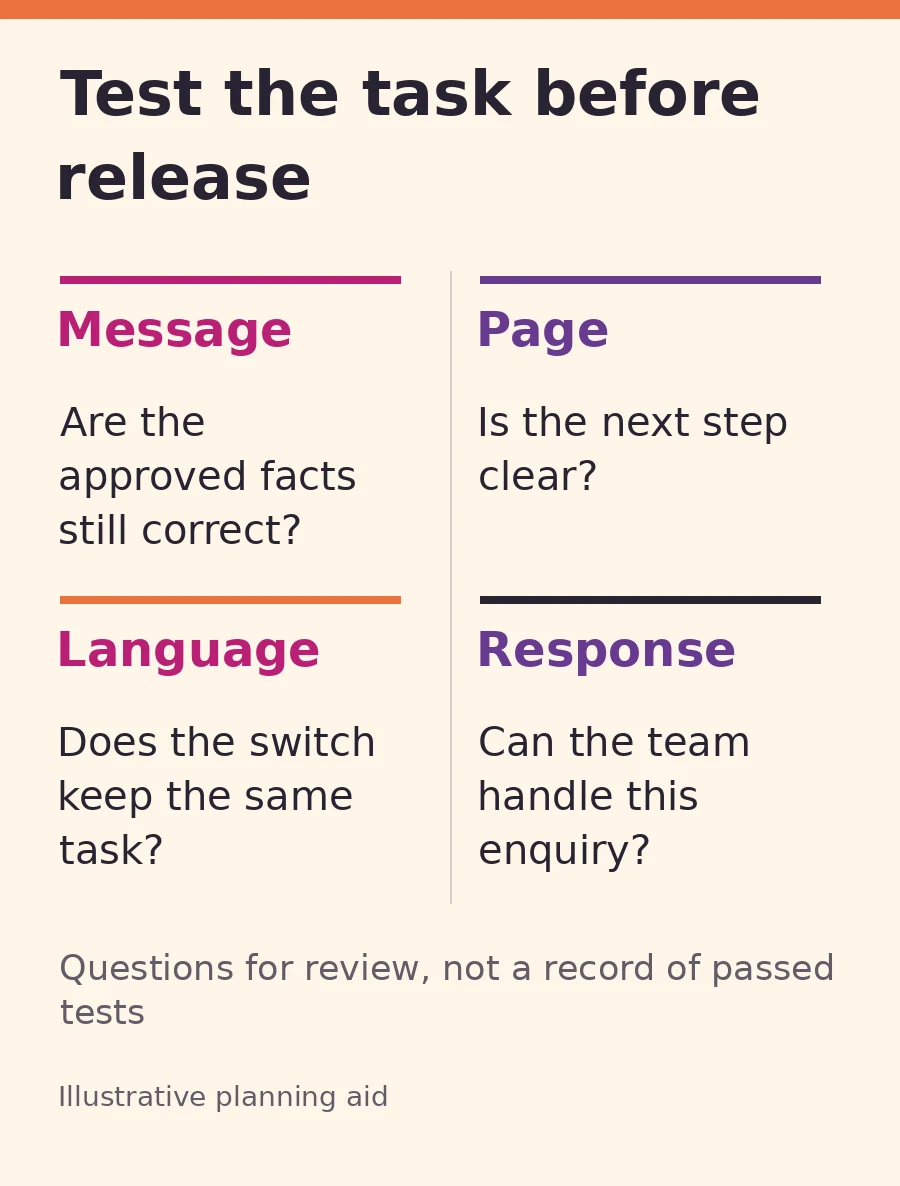
Keep a short review record connecting the approved service fact with its actual Arabic and English wording, both page URLs, requested action, response owner and outstanding checks. Assign a person to confirm the business facts, a language reviewer to check the actual wording and someone to verify the live implementation. Record which version was approved and what must be rechecked when the offer changes
Before launch, open both destinations on a phone, switch language and follow the intended action. If a test enquiry is authorised, identify it clearly and confirm that it reaches the responsible team. Check the acknowledgement as well as the button: it should describe what happened without suggesting a booking or agreement that has not occurred
After launch, review delivery and page use alongside the relevant enquiries the business actually receives. Keep the offer, audience, destination, period and any other changes visible when interpreting differences. A higher click rate does not establish better enquiry quality, and a difference between two language versions does not show that the language alone caused it
Start with one approved offer and prepare both language routes as a single deliverable. ADAMS Content Marketing can help shape the message, while the agreed campaign scope should identify page implementation, advertising and response responsibilities. Share the campaign and the decision your audience needs to make so the work can be scoped clearly