

A website can be live while its renewals, access and recovery arrangements remain unclear. Domain and hosting handover should leave your business knowing which services it depends on, who is responsible for them and how an authorised person can obtain help or make an agreed change
The useful deliverable is a verified service and responsibility record, supported by appropriate access and recovery evidence. A working homepage, a paid invoice or a folder labelled “backup” does not answer all those questions
Main image: concept illustration of a digital handover, not an actual client, ADAMS team or platform interface
Identify the separate services behind the website
Ask your supplier to identify each service in the actual setup. One company may provide several of them, but they still have different functions and may have separate accounts, renewal dates and support arrangements
- Domain registration: the registered name and the organisation providing its registration service
- DNS management: the service managing the records that direct the domain’s website, email and other services
- Website hosting: the environment that stores and runs the website, with the agreed resources and limits
- Website administration: the content-management access used to operate the site, such as WordPress
- Business email: the provider, mailboxes and email administration arrangements, whether bundled with hosting or supplied separately
Record the provider and responsible business contact for each item. Access to a WordPress dashboard does not establish control over domain registration, and access to DNS records does not replace access to the hosting or email service
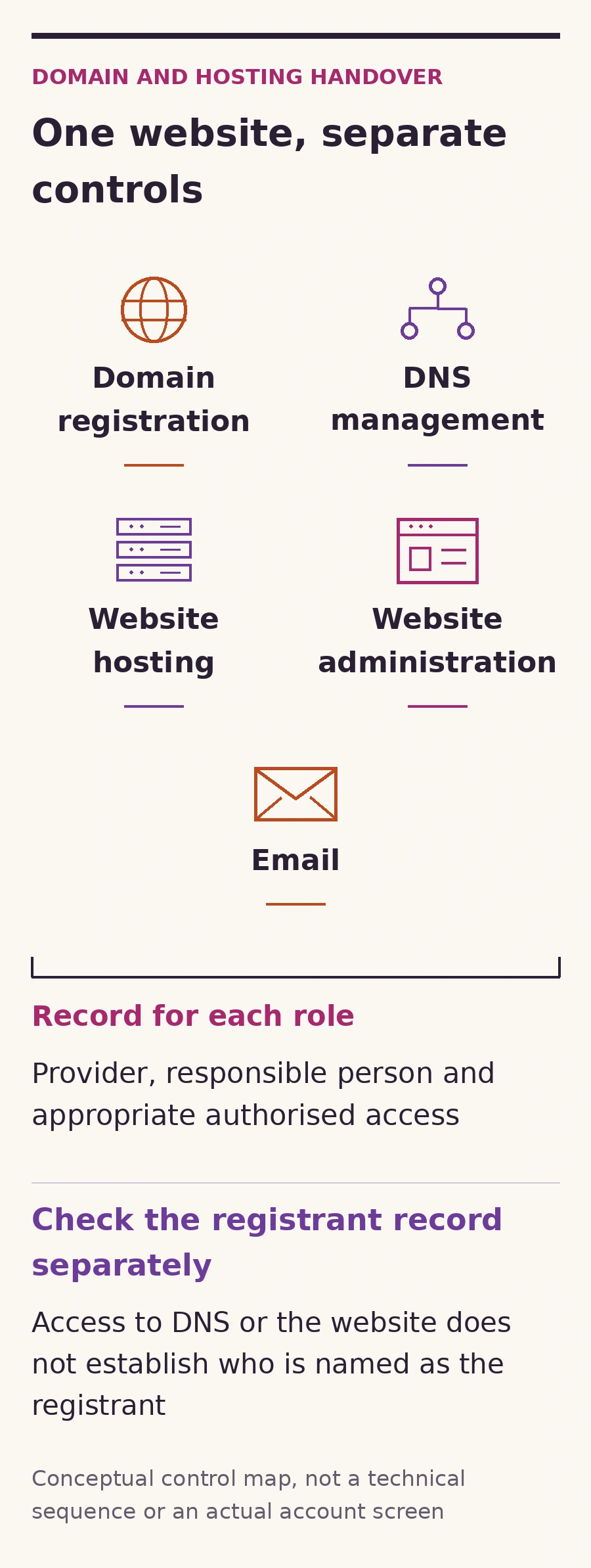
Check registration details and access as different questions
For the domain, identify the registrar, any reseller involved and the individual or organisation recorded as the registered holder. Ask the supplier to explain how that record corresponds to your agreement and how the business can verify it through the provider’s authorised process. The person paying a bill, the account administrator and the registered holder may have different roles
ICANN’s explanation for registrants distinguishes the person or entity registering a domain from the registrar providing the registration service. Its registrant rights and responsibilities include access to information about management, renewal and transfer processes in the ICANN-accredited registration context. Check the actual registrar and registry rules for your domain; do not assume that all country-code domains follow an identical process
Then verify the business’s agreed access and recovery route. This may be a business-controlled account, an authorised role on the relevant service or a documented managed-service arrangement. A public lookup or a login screenshot alone does not settle a disputed registration or prove that the agreed access works
Managed hosting does not mean handing over the supplier’s master or reseller account, other clients’ information or unrestricted server access. Ask for access scoped to your service, or a clear written process for administration, export, recovery and an agreed move. Keep passwords and recovery codes out of shared handover documents
Make renewal responsibility visible
For each paid service, record the renewal date, billing period, current renewal terms, payer, approving contact and person responsible for checking completion. Separate an introductory or first-registration charge from the applicable renewal charge, and confirm which services are included rather than assuming one payment covers everything
ICANN’s renewal guidance stresses renewing before expiry and keeping contact information current. Confirm the provider’s actual terms and reminder route. If automatic renewal is enabled, verify its status and funding arrangements with the authorised person; the label alone is not evidence that a renewal payment has succeeded
Keep the renewal record usable if the current employee or supplier changes. The business should know where notices go, who reviews them and how to confirm the service remains active, without circulating private payment details
Separate a website move from domain and email changes
Clarify whether a proposed change concerns domain registration, DNS management, website hosting, mailboxes or website administration. Moving website files to another host does not by itself describe what will happen to the domain registration or email
Cloudflare’s DNS documentation distinguishes records for website addressing from mail-routing records such as MX. The handover should identify who maintains the current records and which services depend on them. Have the responsible technical team assess any planned change, including email, rather than treating a nameserver change as an administrative shortcut
Consider a hypothetical consultancy moving its website hosting while retaining its existing domain-registration and email providers. Its handover needs to identify all three arrangements and the DNS responsibility between them. A successful website move would not, on its own, demonstrate that mailboxes were transferred or that email sending and receipt were checked. This example describes a planning situation, not ADAMS client work or a completed migration
Ask what can actually be recovered
Request a record of what is backed up, where the permitted copies are held, how long they are retained, who can request recovery and what the restore process covers. Include the date and outcome of an authorised restore test where one has been agreed. The presence of a backup file is different from evidence that it can restore the required service
For a typical WordPress website, the official backup guidance explains that both files and the database are needed for a full restoration. The Tools Export documentation describes a content export, such as posts and pages. A content-export file should therefore not be presented as a complete website backup
Also establish who can use the supplied backup format. For example, cPanel’s Backup Wizard documentation notes that the cPanel interface cannot automatically restore a full backup and directs users to the hosting provider for help. A downloadable archive does not necessarily give the business a self-service restore button
Check email recovery separately: a website backup does not establish that mailbox messages are included. Agree an authorised test in a suitable environment, with responsibility for avoiding changes to live data. Store backup copies and restore evidence through the agreed restricted-access arrangements, since they may contain private information
Define what support continues after handover
Separate website delivery, hosting, domain renewal, email support and ongoing website care in the written scope. Hosting availability does not, by itself, specify who updates the website, edits its content, renews third-party licences or investigates a failed enquiry form
Ask what is included, what needs a separate request, how support is contacted and who handles a problem involving more than one provider. Document any agreed limits, response arrangements, licence dependencies and exit or migration assistance. Do not infer unlimited support or transfer rights from the word “managed”
If you are still comparing proposals, our business website scope and cost guide helps separate the initial build from continuing services. The handover should reflect the work actually agreed, rather than add responsibilities that were never included
Finish with a record the business can verify
For each service, keep the provider, responsible person, agreed access or administration route, renewal responsibility and recovery or exit process together. Mark each item as verified or unresolved, and record the evidence without including secrets. A named person and an expected next step make an unresolved item actionable
Before approving completion, ask the supplier to demonstrate the agreed access, explain the renewal record and show the available recovery evidence. Record exceptions and the plan to resolve them. This provides a clearer handover than simply confirming that the site opens
ADAMS provides domain and hosting services with scope agreed around the business’s requirements. Tell us which services and responsibilities you need to clarify, so that the proposed setup, ongoing work and handover can be defined together