

Your report records WhatsApp clicks, while the sales team talks about enquiries and quotations. Before comparing the totals, agree what each record represents, when it enters the report and who confirms its status
Useful WhatsApp enquiry measurement needs a short set of counting rules and a business-side enquiry record. The aim is to explain what the evidence confirms, including requests still awaiting assessment and enquiries whose marketing source remains unknown
Main image: Concept illustration of reviewing enquiry evidence, not an actual platform interface or client result
Keep the website event and the enquiry record separate
This guide concerns links from your website to WhatsApp. An advertisement that opens WhatsApp directly needs its own platform measurement review; a website event does not cover that route
WhatsApp’s click-to-chat guidance explains that the link opens a chat and that a pre-filled message appears in the text field. Neither action confirms that the visitor sent that message. Record a website click as a contact interaction; confirm a received enquiry from the business’s actual incoming requests
Google Analytics’ outbound-click documentation describes links to another domain, when the relevant measurement is enabled. Ask the measurement owner to test the actual WhatsApp button and event, including repeated activation, rather than assuming every link, app-opening method or custom button is covered correctly
The event count is not a count of distinct people, requests or qualified enquiries. If the contact route itself is unreliable, use the website enquiry-journey diagnostic first. Changing reporting definitions cannot fix a failed delivery
Agree the unit you are counting
For an enquiry register, a practical starting unit is a distinct business request or opportunity. Agree how your business recognises it before choosing a total. A customer sending a specification, correcting a date and following up on the same request should not create a new enquiry with every message
Keep repeat messages attached to the existing case through an internal reference. A genuinely separate requirement may justify a new case, even from the same person. Decide how existing-customer support and new work from existing customers are reported, so they are not silently mixed with new-customer acquisition
Record tests, spam and unrelated contacts separately. Keep genuine but unsuitable business requests visible with their reasons; removing them would hide information about the audience and offer. Document exclusions and apply the same rules throughout the comparison
Separate suitability from sales progress
An enquiry becomes qualified when the responsible person has checked it against agreed criteria, such as the required service, supported market and necessary project requirements. Qualification does not mean a proposal was accepted or money was received
Use the following as a starting vocabulary, adapted to your actual process. Keep suitability and commercial progress in separate fields, so a proposal update does not erase the qualification decision
| Record | Evidence required | Avoid assuming |
|---|---|---|
| Qualified enquiry | The agreed suitability criteria have been checked and met | A qualified request is a completed sale |
| Unsuitable enquiry | A recorded reason, such as a service outside the agreed offer | Every unanswered question means poor fit |
| Awaiting review | The responsible person has not yet assessed the request | An unreviewed request has failed qualification |
| Awaiting information | Assessment needs a specific missing detail | An incomplete request is unsuitable |
| Commercial progress | A separately confirmed milestone, such as a proposal sent or accepted | Sending a proposal means it was accepted |
Give each pending case an owner and next action. “Target market not yet confirmed” is a useful reason to ask a question; it is not evidence that the request is unsuitable. Date status changes so the team can explain a revised total later
Keep a minimal working record
A controlled spreadsheet can be sufficient for a manageable process; a customer relationship management system may be more appropriate when cases, access and follow-up become difficult to maintain. The essential requirement is consistent updating, not a particular product
Use this blank structure as a starting point for the authorised internal register, rather than as a form requesting customer data for an analytics dashboard
- Case reference and first-received date: identify the distinct request and its reporting period
- Source and confidence: record the available evidence, or mark the source unknown
- Suitability status and reason: include the assessment date and any missing information
- Owner and next action: identify who updates the case and what is outstanding
- Commercial milestone and date: record the agreed outcome separately from suitability
- Review cut-off: state when the report’s case statuses were last checked
Keep customer details in the appropriately restricted business system and share only the reporting information needed. Do not send private chat text, personal phone numbers or email addresses to Analytics. Google’s privacy guidance also covers information embedded in URLs and parameters: review the complete WhatsApp link and any pre-filled text collected by the implementation. A query-parameter filter does not establish that every part of a URL is safe
Compare requests from the same period
Choose requests first received within a defined period, then review their status as of a stated cut-off. This answers “What happened to that period’s enquiries?” Keep a separate activity view for proposals or sales completed during the period, because those may concern older requests
If you report a qualification rate, state the denominator. Qualified enquiries divided by all genuine, distinct requests in that group answers a different question from qualified enquiries divided only by assessed requests. Show pending cases alongside either measure, and keep the definition stable
Recent requests have had less time to be assessed or progress. Google Ads’ conversion-delay guidance explains why recent periods can be incomplete. For your business register, use a review point suited to the actual sales process and label unresolved outcomes; do not invent a universal waiting period
Compare the website events and business records as separate evidence sources. A repeated click, a saved contact, another device or an unrecorded referral can prevent a dependable connection. Record a source only as confidently as the evidence allows. Do not force every enquiry into a campaign or divide one campaign’s spend by enquiries from every source. For the wider reporting context, see what a digital marketing report should explain
Check what the advertising system uses as its goal
In Google Ads’ qualified and converted lead definitions, qualification is assessed beyond the initial ad interaction in a CRM or internal system. A converted lead represents the chosen completed step; its label does not always mean a sale. Agree the actual business milestone before interpreting either category
Review the live campaign goals with the person responsible for measurement. Google Ads distinguishes primary and secondary conversion actions: primary actions can guide bidding when their standard goal is used, while secondary actions generally support observation. Actions in a custom goal are an important exception and can be used for bidding regardless of that label
A click can remain a useful early signal when that is the available evidence. It should still be named accurately. Moving to a later-stage goal needs dependable case updates, suitable data and a correctly tested, permitted connection to the platform. Renaming a click “qualified lead” creates none of those conditions
A hypothetical request: update the case, then update the report
Imagine a fictional business asking an agency about advertising a new service. The incoming message confirms that a request arrived, but the target market has not been established. Record it as awaiting information, assign someone to clarify the market and keep the source unknown if no reliable connection is available. This is an illustrative example, not ADAMS client data or a measured result
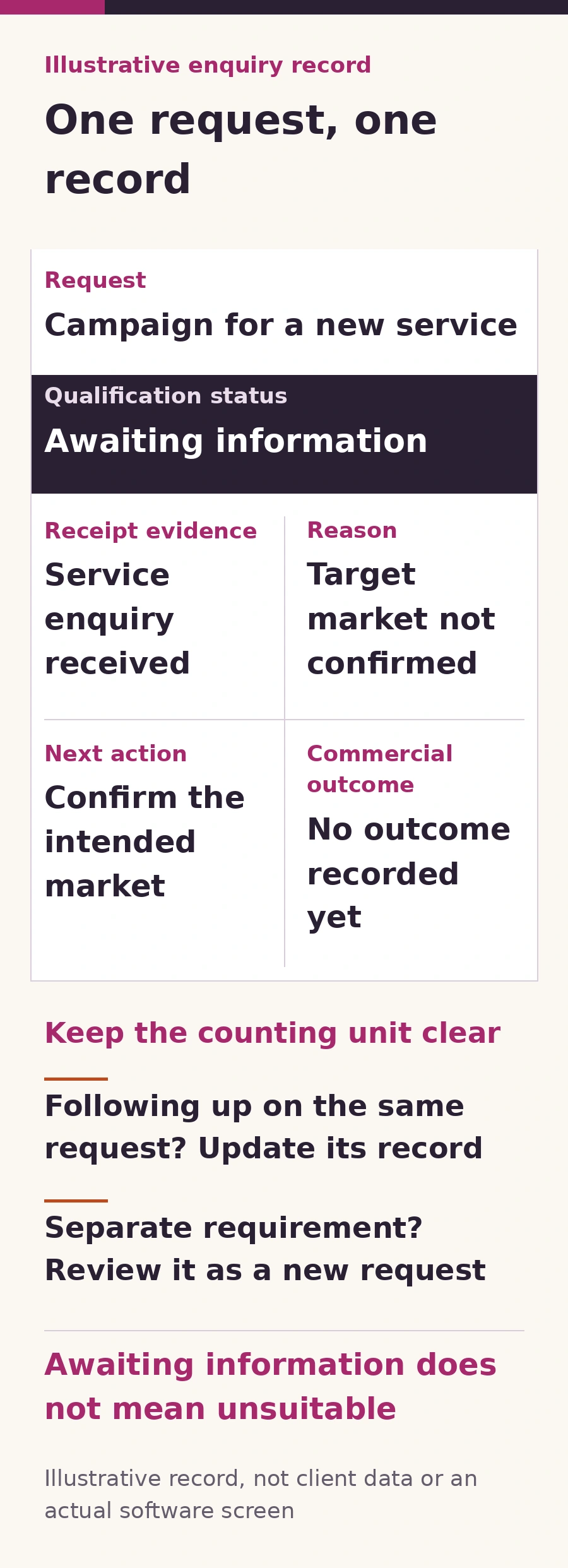
If the later answers meet the agreed suitability criteria, update the same case to qualified with its assessment date. A follow-up containing revised service details remains part of that opportunity. Sending a proposal is a separate milestone; acceptance and payment require their own confirmation
When reviewing the original enquiry period, show the case’s latest status as of the review cut-off. When reviewing current sales activity, record the proposal under its own date. Those views answer different questions without creating an extra lead or claiming an unsupported sale
Before your next report, agree the counting unit, qualification rules, exclusions, owner and review cut-off. ADAMS can review how your paid advertising reports relate to the business records available. Tell us which contact route and reporting decision you need to clarify; any tracking integration, CRM work and sales follow-up should have a separately agreed scope