

Main image: illustrative marketing review meeting, not a client project or a photograph of the ADAMS team
A digital marketing report should help you decide what to keep, what to investigate and what to change. A collection of screenshots can show that work happened, yet still leave you unsure whether the business received useful enquiries or what the team should do next
The useful report connects evidence to a decision. It explains where the information comes from, what each measure actually records and where the connection to a business outcome remains uncertain. You should be able to follow that reasoning without becoming an analytics specialist
Start with the business question the report needs to answer
Decide what the reporting conversation is for. You might need to understand whether the agreed work was delivered, whether prospective customers are finding the right service or whether enquiries contain enough information for the business to respond usefully
Those questions need different evidence. A publishing record can confirm that an article went live. Website analytics can describe recorded interactions. The team handling enquiries can confirm what arrived and whether a request was relevant. None of those sources should be quietly substituted for another
Ask for a short opening explanation: what changed, what evidence supports that observation and which decision needs attention. Detailed channel information can follow. The first page should give you a way into the discussion rather than make you search through every chart for a conclusion
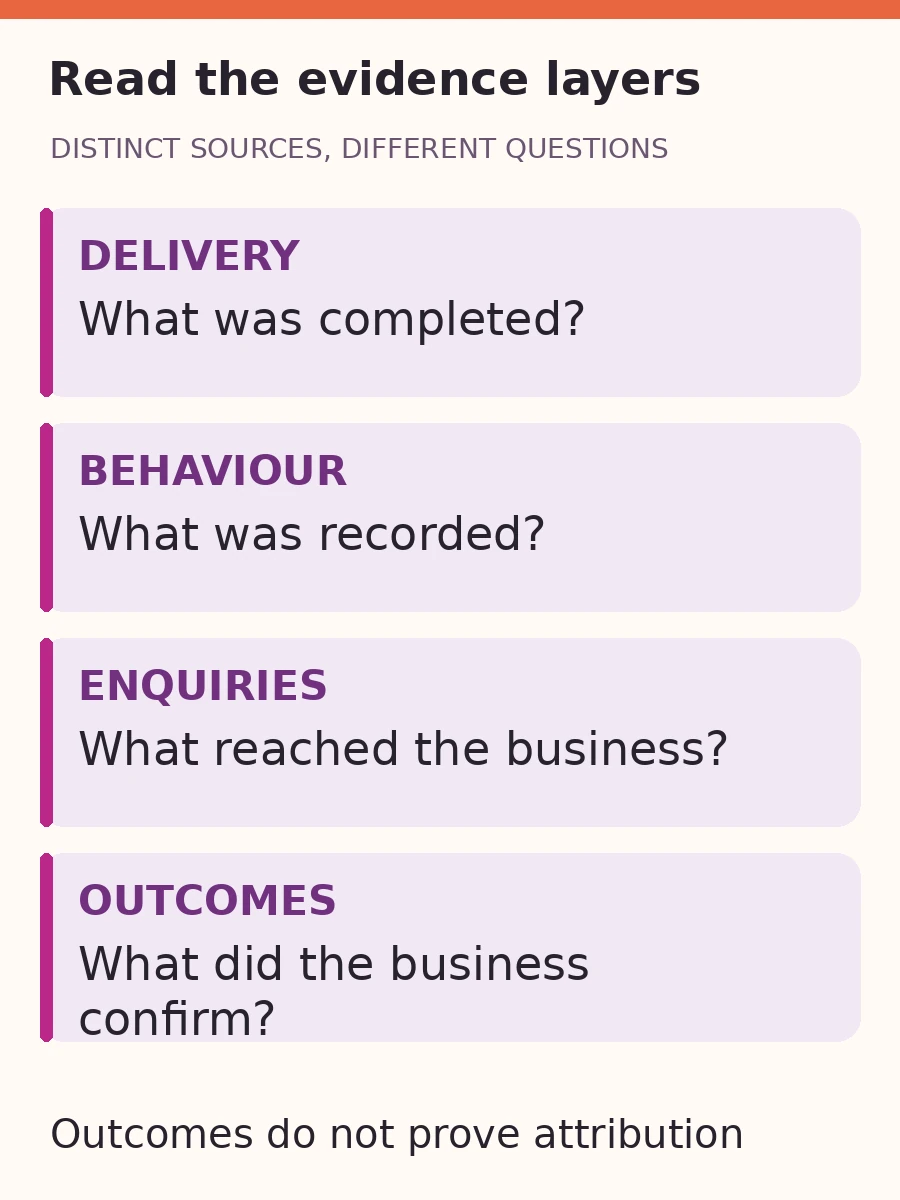
Separate completed work from customer behaviour and business outcomes
A clear report keeps different kinds of evidence visible. They are related questions, not a guaranteed sequence in which every interaction becomes a customer
- Delivery: what the team completed, published, maintained or changed within the agreed scope
- Recorded behaviour: what the relevant platform or website measurement system observed
- Received enquiries: what actually reached the business through the contact routes being reviewed
- Business outcomes: what the business can confirm about suitability, progress, customers or completed work
Delivery matters because a service needs accountability. It does not, by itself, demonstrate commercial impact. Equally, an outcome recorded by the business does not automatically establish which marketing activity caused it. The report needs to explain any connection it claims to have measured
Read the definition behind an enquiry or conversion label
Before judging a result, ask what triggered its recording. A contact-button click, a submitted form, a received message and an assessed enquiry are different events. A report should name the event instead of relying on a reassuring column heading
Google Analytics defines a key event as a measured action particularly important to the business. The team chooses or creates an event and marks it accordingly. That designation does not independently verify that the event represents a genuine sales enquiry
For a received-enquiry measure, agree which source record confirms receipt and how spam, duplicates and unrelated requests are treated. If the report says an enquiry is qualified, explain the criteria and who applies them. Keep personal details out of a general reporting presentation and use appropriate access for any underlying checks
Where contact happens by phone or messaging, be precise about what is known. Opening a messaging app does not establish that a message was sent, received or answered. If the business cannot reliably connect a later customer to a particular interaction, record that limitation
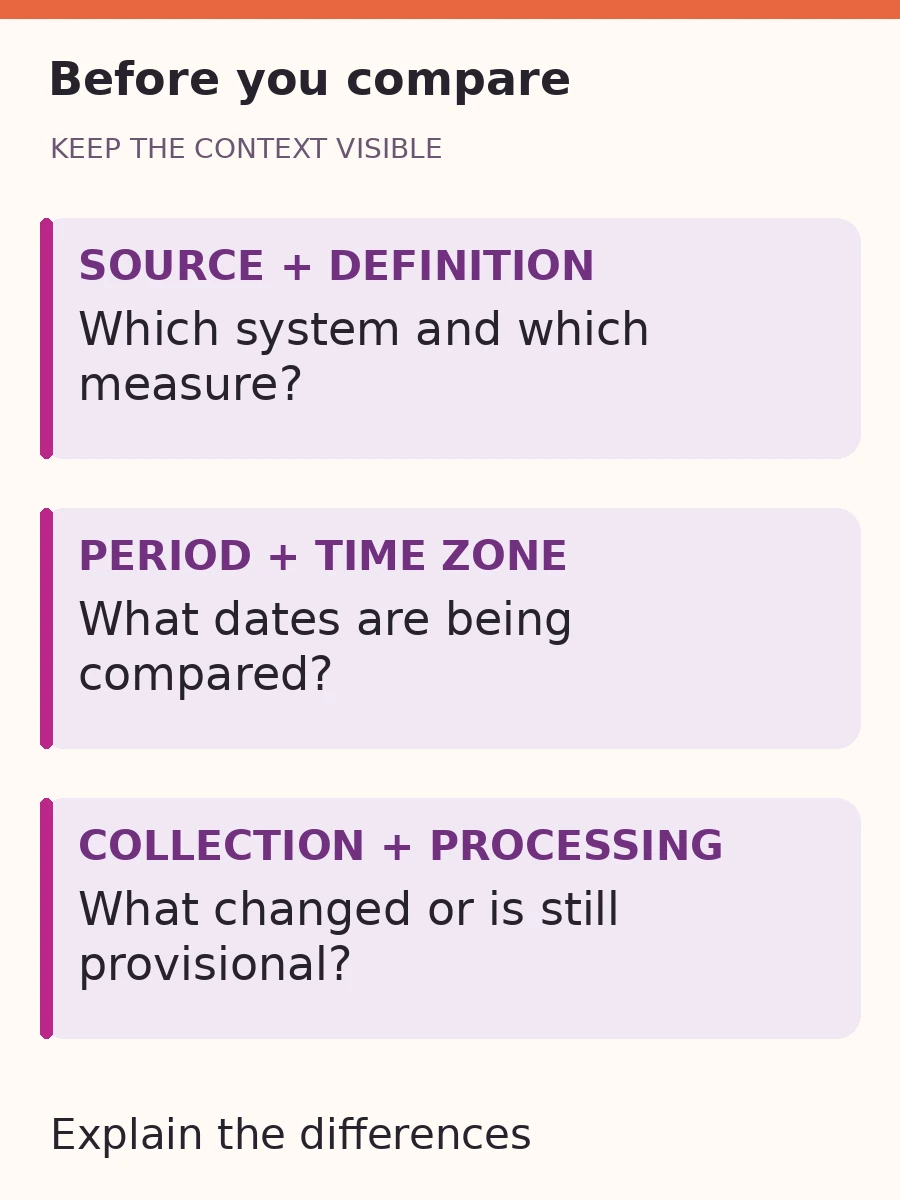
Check whether the comparison is actually comparable
A change only becomes useful when you understand what was compared. Record the reporting period, comparison period, time zone, source and metric definition. If a rate appears, explain what is being divided by what. Similar labels can describe different populations or actions
Also note changes to measurement, campaign activity, service availability or the material being promoted. A tracking correction may change what gets recorded without an equivalent change in real customer behaviour. A shorter reporting period or an unfinished period needs context before it is compared with a completed one
Google’s data freshness guidance explains that Analytics data is processed at different intervals and reports can change while processing continues. Label provisional information and state when it was extracted. Do not present an early snapshot as a settled final result
Why ad clicks and website sessions may differ
Google’s clicks and sessions guidance explains that these are different measures. Repeated ad interactions, a page closing before measurement loads and implementation issues are among the possible reasons for differences. Those possibilities need investigation in the account concerned; a discrepancy alone does not identify the cause
A missing recorded session does not prove that a person never reached the website. The reporting team should check collection and definitions before forcing the totals to match or declaring one system wrong. Keep the original sources identified so the difference can be explained
Distinguish attribution credit from proof of additional impact
Attribution describes how credit is assigned to interactions associated with an important action. Google’s attribution settings guidance explains that the reporting model and lookback window affect how that credit is handled. A report should state the relevant settings rather than leave the reader to assume them
This matters when channels appear to claim the same business result. Before adding their reported totals together, check what each source counts and how it assigns credit. A shared outcome should not become several new customers merely because it appears in several reports
The question “Which interaction received credit?” differs from “What additional outcome happened because of this activity?” Google’s Conversion Lift documentation makes this distinction between standard attributed conversions and incremental impact measured through an experiment
You do not need to turn every reporting meeting into an experiment. You do need to avoid presenting an attribution total as conclusive proof of additional business. Where a causal question matters, agree suitable measurement work and its requirements separately. The report should describe the evidence available, without implying that a study has been run
Ask for an explanation that can be checked
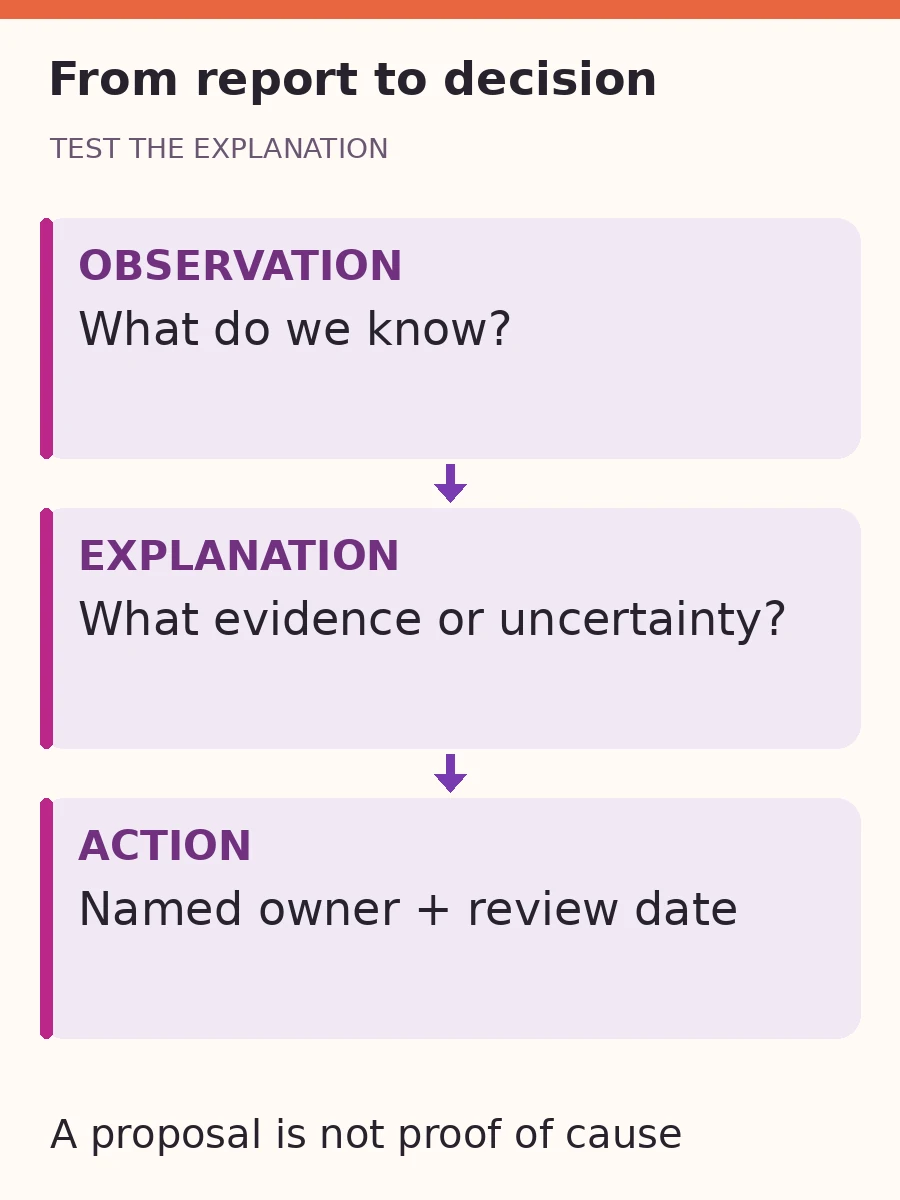
A useful explanation separates the observation from the proposed reason. “The report recorded more contact interactions” describes a measurement. “The new content caused better enquiries” makes a further claim that needs supporting evidence about the content, the requests and their relationship
Consider an illustrative service-business review: contact interactions appear to have increased, but the team has not yet checked received requests. The appropriate conclusion is that recorded contact activity changed. The next check is to review the event definition and the available receipt records, rather than announce that lead quality improved
If requests later prove more relevant, the team can describe what it found and how relevance was assessed. It should still distinguish that observation from a proven explanation of why it happened. A different offer, distribution change, business availability or measurement change may need consideration
Ask what remains unknown and what evidence would help resolve it. A small or incomplete set of observations may justify further checking rather than a confident conclusion. “We cannot yet establish the cause” can be useful reporting when it is followed by a specific investigation
Finish with a decision, an owner and a review point
The next action should follow from the evidence. It might be to verify an event, reconcile enquiry records, clarify a service explanation or keep a useful activity running while more information becomes available. Avoid a list of unrelated recommendations added simply to make the report look substantial
For each proposed action, record the decision being made, the named owner, the check or evidence required and when the team will review it. If a recommendation needs work outside the agreed scope, make that visible before treating it as an included deliverable
Budget and channel decisions deserve the same discipline. If the next discussion is about where to focus the work, use a framework for choosing SEO or paid ads alongside the report’s evidence. A busy channel, a large activity list or an attractive chart does not make that decision on its own
Before accepting your next digital marketing report, check that you can answer these questions: what was completed, what was measured, what the business confirmed, what remains uncertain and what happens next. If those answers are clear, the report becomes a working tool for the business
If you need help connecting channel activity to priorities, explore marketing strategy with ADAMS. Bring the reports you already receive and the decisions you need to make, so the review starts with the information your business can actually use