
You have enough budget to make one serious marketing investment, but not enough to fund every channel properly. Should you improve organic search visibility or start paying for traffic?
The useful answer depends on what the business needs to learn or achieve next. A hotel with available meeting dates faces a different decision from an industrial supplier whose buyers spend months comparing specifications. Neither urgency nor a preference for long-term growth settles the question on its own.
This framework focuses on organic search and paid search advertising. Paid social and other discovery campaigns can serve different purposes. Here, “first” means the next funded phase, with a defined scope and review point, rather than a permanent commitment to one channel.
Define the commercial job before choosing a channel
Start with one offer in one market. “Get more leads” leaves too many decisions unresolved. “Generate suitable enquiries for our commercial maintenance service in the cities we cover” gives you a basis for choosing pages, search terms and a useful contact action.
Write down the offer, the buyer, the service area, the outcome and the timing constraint. Separate the date you want a campaign to launch from the date you need revenue to arrive. A campaign can begin delivering traffic while the sales process still takes weeks to produce a decision.
Also name the uncertainty. Are suitable buyers searching for the service? Do they understand your proposition? Can the business acquire customers at an affordable cost? A channel plan should explain which uncertainty it can investigate, and which questions will remain unanswered.
Check whether the business can use additional demand
Before buying traffic or expanding content, confirm that the offer is available, the destination page explains it accurately and someone can handle new requests. Check stock, booking availability or delivery capacity as appropriate. An unsupported location can make an otherwise relevant enquiry unusable.
A short readiness check is enough for this decision. If the page already receives suitable visits but produces few enquiries, use our guide to finding where the enquiry journey breaks down before allocating more money to acquisition.
Google’s guidance on ads and landing pages supports matching the destination to the offer and the intended action. That is a condition to examine, not a guarantee that a ready-looking page will sell.
Establish what buyers are already looking for
Organic search and search ads can both reach people expressing an existing need. The distinction is not simply “SEO creates awareness, ads create sales”. A technical article may help a buyer compare options; a search ad may answer an urgent supplier request. Both still depend on what the person searched for and what you offer.
Review customer language, relevant search results and your own query data where available. Look for commercially meaningful distinctions: repair versus replacement, wholesale versus retail, training versus implementation. A large collection of loosely related searches is not evidence of demand for your specific service.
For a business serving Egypt or several MENA markets, check Arabic and English terminology separately. Buyers may use a brand, a local expression or a technical term rather than a direct translation. Confirm that the business can serve the location and language represented by the proposed campaign.
If people do not yet understand the category or recognise the problem, customer research or an appropriate discovery campaign may be a better first test. Choosing search simply because its clicks appear measurable does not establish that enough relevant searches exist. Equally, a low-volume estimate alone does not prove that demand is absent.
Compare the full cost of each option
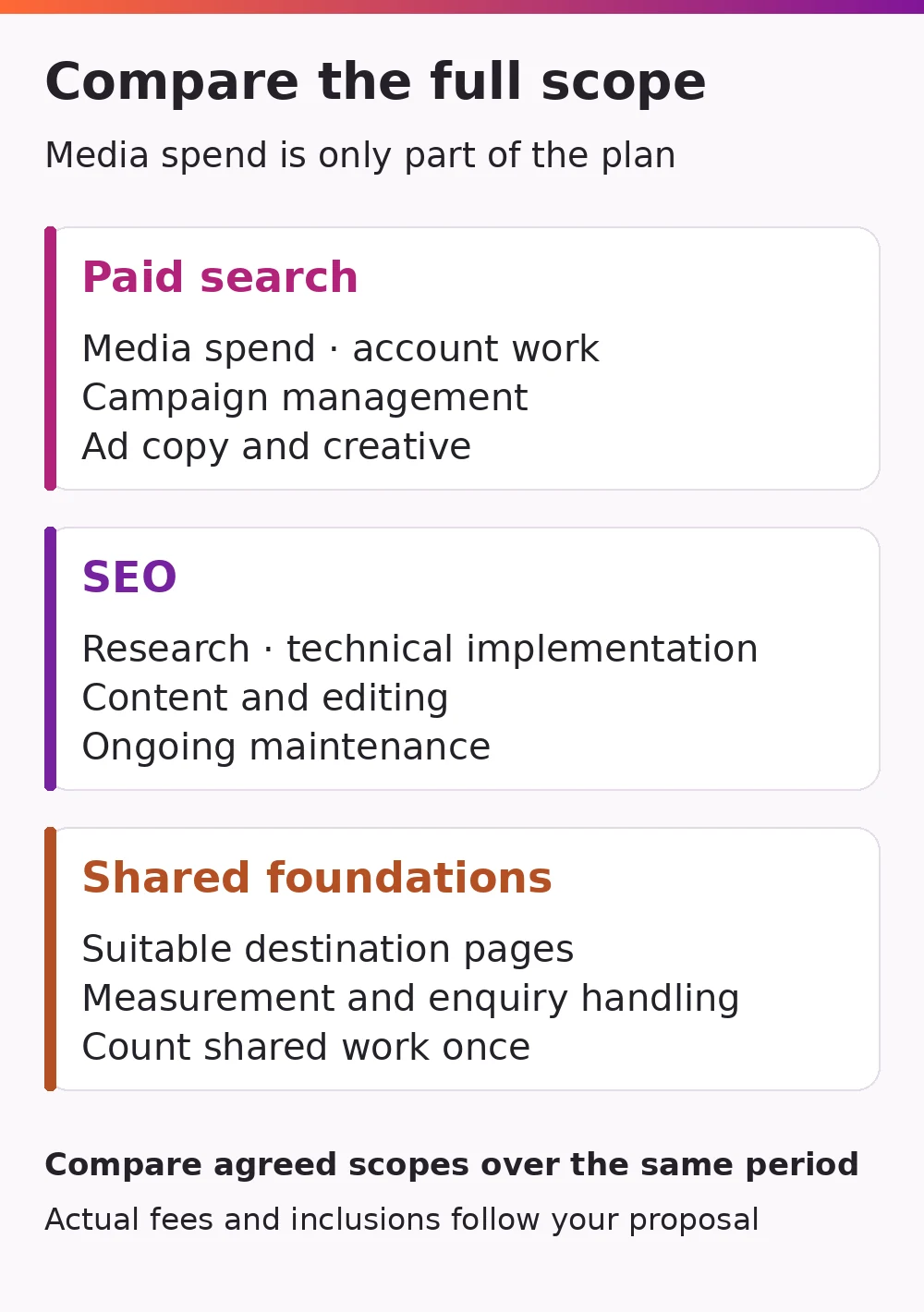
A paid-search proposal needs more than a media budget. Include account work, management, creative where relevant, landing-page preparation, measurement and staff time reviewing enquiry quality. Keep the amount paid to the advertising platform visible as a separate line.
An SEO proposal also consumes resources: research, technical implementation, useful content, access to subject expertise, editing and ongoing maintenance. Organic clicks do not carry a media charge, but producing and maintaining the pages behind them is not free.
Identify shared foundations once. If both options need the same service page and working measurement, do not count the entire cost twice when comparing a combined plan. Compare realistic scopes over a stated planning period, rather than comparing an SEO retainer with ad spend alone.
Use customer economics to judge affordability
Use your own margins, sales records and payment terms to decide what the business can afford to spend on acquisition. Start with what remains after delivering the sale, while allowing for overhead, profit and the timing of cash receipts. Include repeat business only when you have evidence for it.
Keep the costs included in that decision consistent with the scope you are comparing. A platform cost per click is different from the full cost of acquiring a customer. Campaign management, content, implementation and your team’s time may all affect the comparison.
If reliable enquiry-to-customer data is missing, record that gap and agree how you will collect it. Do not substitute an assumed close rate for observed performance or commit to a budget based on an unsupported forecast.
SEO or paid ads first: choose the next funded phase
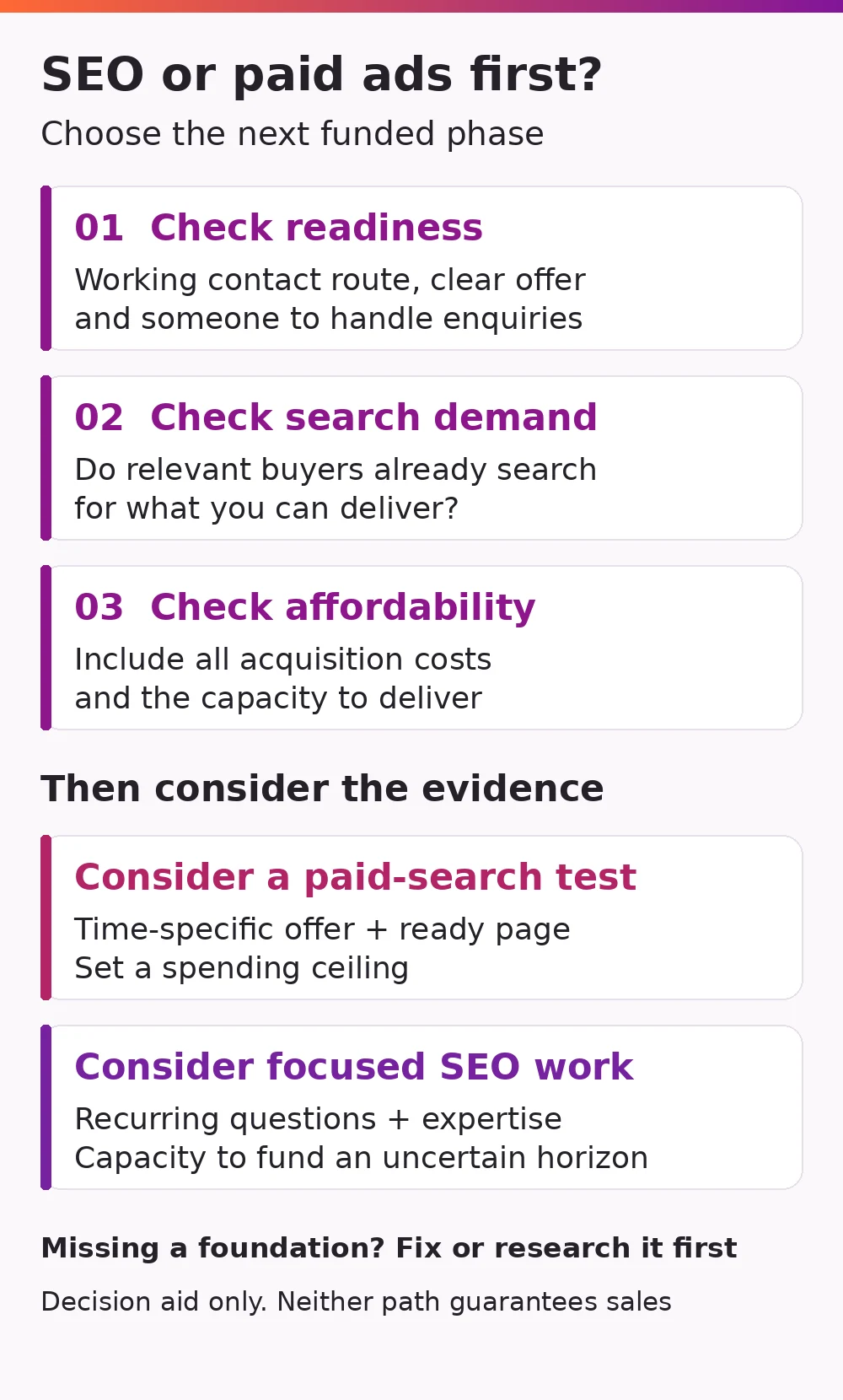
Use the following as a decision aid. Each recommendation depends on evidence you can challenge; it is not a scoring system that produces a universal winner.
On a small screen, scroll the comparison sideways to read all three columns.
| What you know | A reasonable first phase | What could change the decision |
|---|---|---|
| Relevant search demand, a time-specific offer and a ready enquiry route | A tightly scoped paid-search test with a spending ceiling | Unaffordable economics, weak demand or insufficient delivery capacity |
| Recurring buying questions, useful expertise and capacity to fund an uncertain horizon | Focused SEO work on the most relevant pages and content | A revenue deadline this plan cannot realistically support, implementation blockers or an offer buyers do not understand |
| An unfamiliar offer with little demonstrated search demand | Customer research and a suitable message or discovery test | Evidence that relevant buyers already search using different terminology |
| A broken contact route, no enquiry owner or no affordable test scope | Fix readiness issues, or defer acquisition until a viable scope is affordable | A verified repair and a realistic plan for handling additional requests |
A paid-search test can help you observe relevant traffic, but it cannot guarantee enough useful evidence within a fixed number of days. Review ad eligibility, demand, costs, actual enquiries and the sales cycle together. A small test with no sales may remain inconclusive; it is not proof that the whole channel cannot work.
SEO has timing uncertainty too. The Google SEO Starter Guide explains that changes can take different lengths of time to be reflected in Search and may not produce a noticeable effect. Do not build your cash-flow plan around a promised ranking deadline.
Compare two situations without turning them into rules
Hypothetical hospitality example: a venue wants suitable enquiries for specific available meeting dates. If buyers already search for that type of space, a focused paid-search test may be useful. The venue still needs accurate availability, clear location information and someone who can prepare quotes. A short booking window makes time important; it does not make expensive enquiries profitable.
Hypothetical B2B example: an industrial supplier repeatedly answers detailed questions about compatibility, installation and maintenance. If it can provide reliable technical information and fund the work without depending on immediate search revenue, improving its service pages and supporting content may be the better first phase. A limited campaign could still help investigate particular commercial searches. A long sales cycle alone does not mean ads are unsuitable.
Make the hand-off between channels explicit
A company may prioritise paid advertising while maintaining a small, necessary programme of website and content improvements. Another may lead with SEO while reserving a clearly defined advertising test. There is no reason to default to an equal budget split if neither channel receives enough attention to answer its question.
Use findings carefully. Paid-search terms and recorded enquiry objections can suggest content questions. Organic query data can suggest campaign tests. Neither establishes that another channel will achieve the same economics or rankings.
Google’s explanation of paid and organic search reporting also makes the separation clear: spending on advertising does not improve organic rankings. Funding ads alongside SEO is a business sequencing decision, not a way to purchase organic position.
Record what would make you continue, change or stop
Before work begins, record the chosen offer and market, the first phase, its cost ceiling, its owner and the evidence needed for the next decision. Specify a review date and whether the sales cycle will be mature enough to judge commercial outcomes then.
- Fix: a contact route fails, the destination misrepresents the offer or tracking counts the wrong action
- Investigate: relevant traffic arrives, but enquiry quality or sales progression remains uncertain
- Continue within the ceiling: the work is producing relevant evidence and its economics remain plausible
- Reconsider: the scope cannot address the original question, capacity disappears or the business cannot fund the next phase
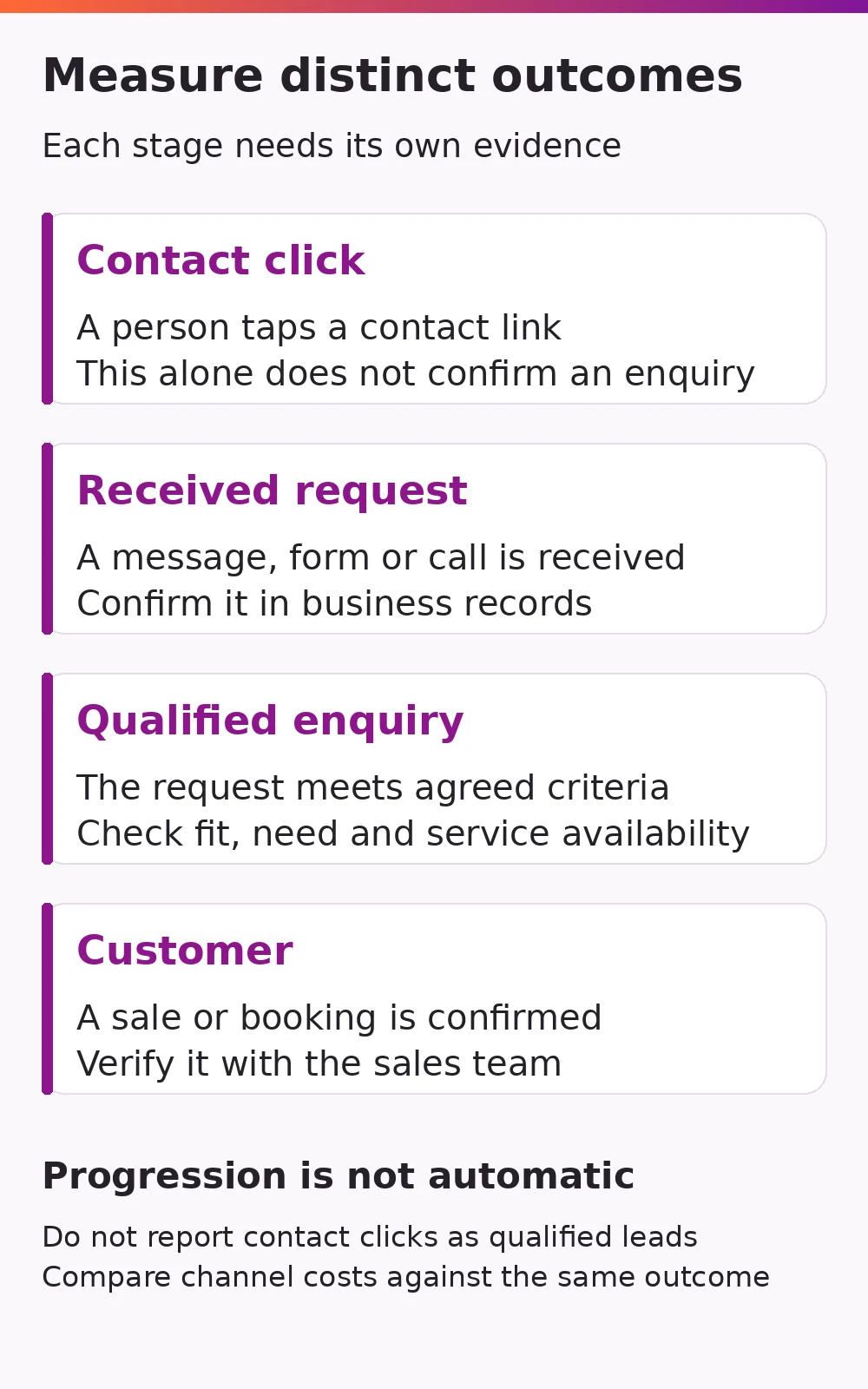
Keep contact clicks, received requests, qualified enquiries and customers distinct. Judge acquisition costs against the same business outcome in each comparison. Platform reports can include observed and modelled attribution; reconcile them with business records before treating reported conversions as qualified enquiries or sales. Attribution also does not, on its own, establish how many sales would have happened without the advertising.
The decision should leave you with a funded next step you can explain: why this offer, why this channel now, what it costs and what evidence would change your mind.
Plan the next phase with ADAMS
Send us the offer you want to grow, the market you serve, your timing constraint and any existing traffic or enquiry evidence. We can use those inputs to discuss a focused scope across marketing strategy, search and campaigns.
If your next phase needs both search and advertising, our services and integrated plans explain how the work can be coordinated. Compare the included scope with your priorities before choosing a plan.