

A B2B service page should help someone decide whether your company is worth contacting for a specific piece of work. A list of capabilities and a “Request a quote” button leaves that decision unfinished if the reader cannot identify the scope, limits, relevant evidence or information needed to begin
This guide shows how to turn those questions into B2B service page content, using a hypothetical warehouse data-network project. It is an editorial framework for improving a service page, not a universal procurement checklist or a technical installation specification
The main image is a conceptual illustration created for this guide, not a client project, a finished installation or evidence of results
Start with the questions behind a supplier enquiry
Speak to the people involved in delivering and selling the service before drafting. Which requests can the company assess? What regularly needs clarification? What information can a buyer reasonably provide before a conversation? Use authorised, anonymised enquiry patterns where available, rather than turning one person’s experience into a rule about every buyer
Nielsen Norman Group’s B2B usability research distinguishes the needs of people using a solution from those choosing it, and identifies compatibility information as important. Apply that distinction to your service: an operational contact may need implementation details, while a purchasing colleague needs enough clarity to compare the proposed scope
The CIPS procurement-process guide also makes clear that purchasing processes vary between organisations. Do not assume that a website enquiry follows a formal tender process, or that one page can satisfy every supplier-approval requirement. Explain the service and the next conversation; let the customer’s actual process determine the later documentation
If you are still deciding whether information belongs in a service page or an article, start with the guide to service pages and blog posts. The task here is narrower: making an existing service offer understandable before a quote is requested
Map buyer questions to verifiable page content
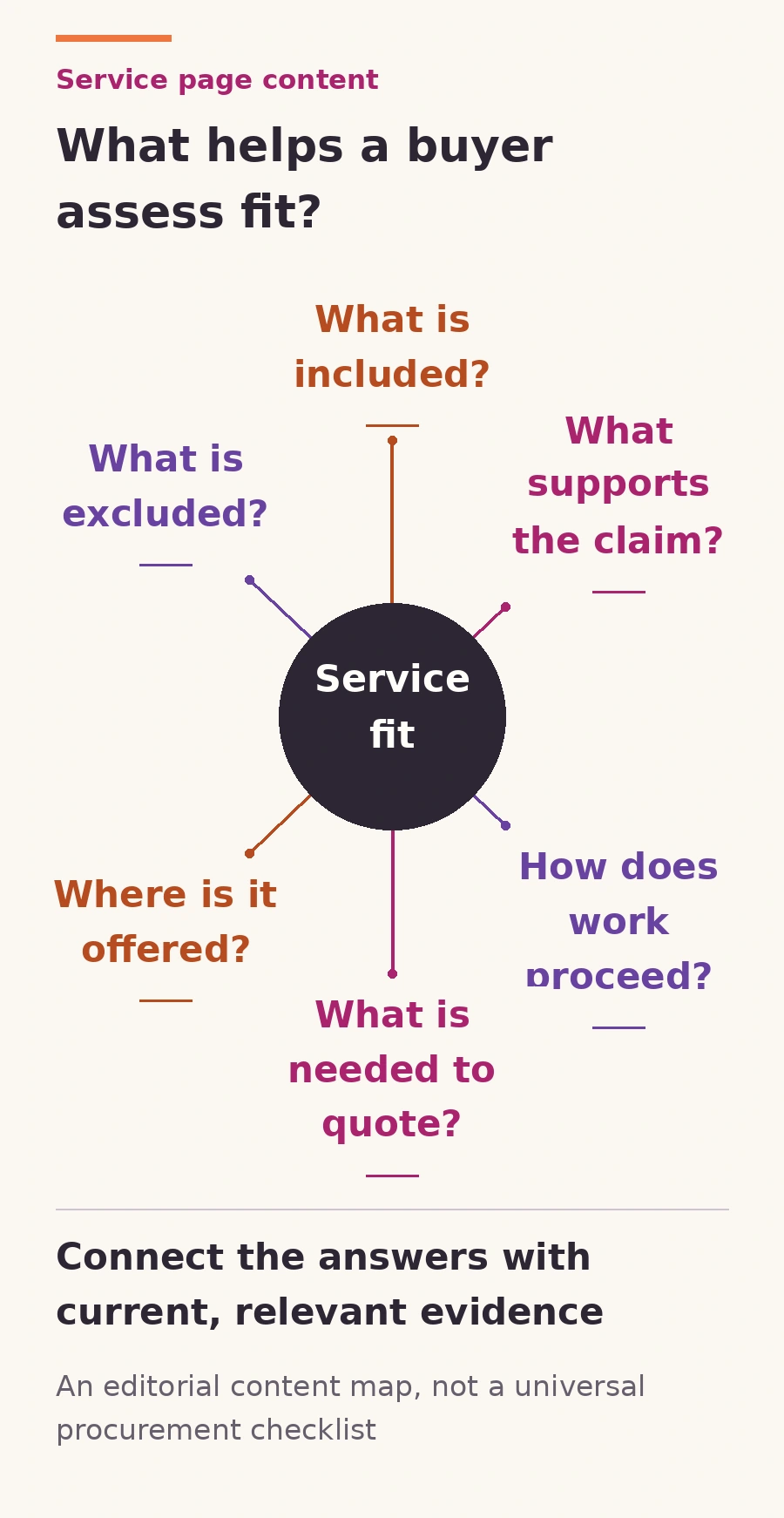
Use the following questions as an ADAMS editorial review aid. The answers must come from the company responsible for the service, and the order should follow the reader’s task rather than a fixed page template
| Buyer question | Content to make visible | Check before publishing |
|---|---|---|
| Does this service fit our requirement? | The work offered, suitable project types and relevant systems or operating contexts | Can the delivery team support each named capability? |
| What is included, and what is not? | Scope boundaries, exclusions and work that needs a separate assessment or agreement | Could the wording imply that an optional task is included? |
| What supports the claim? | Relevant, authorised evidence with enough context to understand what it demonstrates | Does the evidence support this exact statement and scope? |
| Can you work at our location? | Confirmed service areas, remote or on-site arrangements and location-dependent conditions | Has the responsible team approved the coverage wording? |
| What happens after we contact you? | How the request is reviewed, what may need clarification and when further assessment is required | Is the described process the one the team actually follows? |
| What do you need to prepare a quote? | The minimum useful first-contact details and how necessary follow-up information is requested | Is every requested item needed at this stage? |
Do not fill an unanswered row with reassuring language. If a location, supported system or delivery condition is unconfirmed, resolve it before making it a public promise. Describe a genuine assessment step where suitability depends on the project
Make evidence specific enough to mean something
Put supporting evidence near the claim it explains. A project example should identify the work actually carried out and the relevant context, with permission to publish it. If results are stated, they need their own reliable records and an explanation of what was measured. A photograph alone does not prove a service outcome
Check the scope and currency of any certificate, accreditation or partner status before using it. A manufacturer’s logo does not establish that the service provider is an authorised partner, and a qualification held for one activity does not automatically cover every activity named on the page
If no suitable client example can be published, explain the verified working method or use a clearly labelled demonstration. Keep it separate from evidence of completed work. Do not invent customer names, testimonials, project photographs or performance figures to fill a design
Pricing needs the same care. Where an approved price genuinely applies, state its scope and conditions clearly. Where the work needs assessment, explain what determines the quote, such as site conditions, the agreed work and equipment responsibilities. Do not replace a missing price with an invented example or imply that a first enquiry fixes the price
Worked example: a warehouse data-network service page
Hypothetical example: imagine a provider preparing a page for data-network installation in industrial warehouses. This is an invented content-planning scenario, not an ADAMS service, client case or engineering recommendation. Every operational detail would need the provider’s approval before a real page used it
Explain the offer without making a blanket promise
A proposed introduction could describe data-network work for warehouse sites, with the supported activities named after operational review. It should distinguish a new installation from changes to an existing network, and say when a site assessment is required to establish suitability
That is more useful than “complete networking solutions for every business”. It tells the writer which questions to resolve, without claiming that every site, device or requirement is supported
Show the boundaries that change the quote
The draft should identify whether assessment, equipment supply, cabling, configuration, testing, documentation and ongoing support are included, separately scoped or excluded. These are questions for the provider, not a ready-made bundle that the writer can promise
Explain any dependency that materially affects the offer. Existing systems, access arrangements and the customer’s operating constraints may need discussion before scope or timing can be confirmed. Keep technical design and security decisions with the appropriate specialists
Give the buyer a workable next step
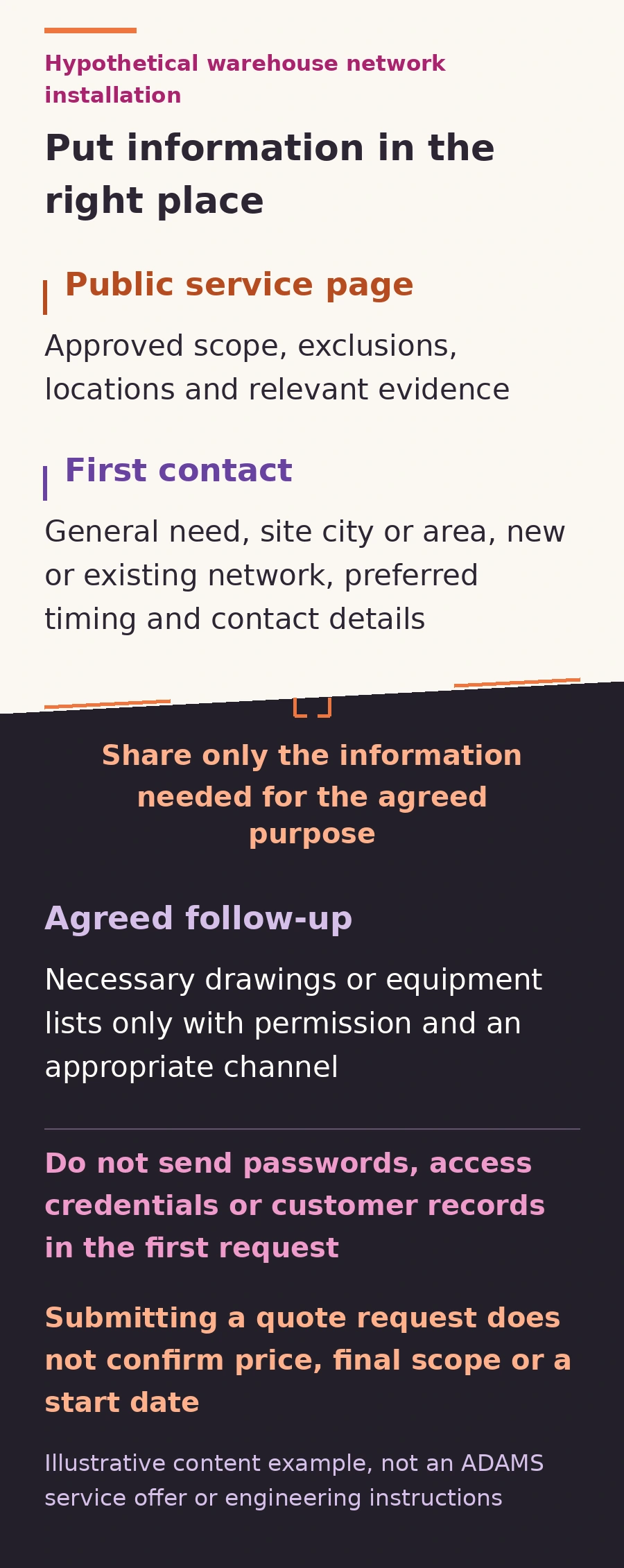
The first request could ask for a general description of the need, the site city or area, whether the network is new or existing, the preferred timing and a business contact. The provider would first check whether it can assess the requirement, then agree which further information or site review is needed
A request for quotation, often shortened to RFQ, asks the supplier to prepare a quotation. Keep the website journey clear: receiving that request is a review step, not confirmation of price, final scope, availability or a start date. Any commitment must follow the provider’s actual review and agreement process
Separate public information from project details
The public service page should explain approved scope, limits, locations, evidence and the enquiry process. The first-contact form should collect only what is necessary to route and assess that initial request. Detailed project material belongs in a later exchange when its purpose, permission and appropriate channel have been agreed
In the warehouse example, the first form does not need passwords, access credentials, customer records or an unrestricted upload of internal network drawings. If a drawing or equipment inventory becomes necessary, explain why, who needs it and how the customer can provide an authorised version through the agreed channel. This is a content and process recommendation, not a claim that a particular messaging service makes information safe
Give the reader a route for uncertainty. They may not yet know the equipment list or precise scope. A general enquiry can be more appropriate than forcing them to invent an answer or send confidential files just to continue
Make the quote request understandable and test it
W3C’s accessible-forms guidance recommends asking only for information needed for the process, identifying controls clearly and providing instructions and feedback. Apply that to the enquiry route: label fields, distinguish required from optional details, explain errors and confirm successful submission
Place a useful explanation beside the action. “Tell us about the site and required work so we can review the request” describes a different next step from “Get your final quote now”. Use whichever promise reflects the service’s real process, and publish a response time only if the company has approved it and can support it
Check the complete route on a phone and with a keyboard. Can someone understand the service, find the quote action, submit the agreed minimum details and recognise whether the request succeeded? Confirm that it reaches the responsible team. If enquiries disappear between the website and the team, review the website enquiry journey rather than adding more persuasive copy to the same broken route
Review one real page before expanding the structure
Choose an important existing service page and mark what the buyer can currently establish, what the team still needs to confirm and what belongs in follow-up. Have the delivery owner approve the facts, the person preparing quotations check the requested inputs, and the content team review clarity and consistency in each language
Use a marketing brief to record unresolved content decisions and the person approving them. Keep a page owner and review date, and revisit the wording when the service, coverage or process changes. Do not create extra pages merely to repeat the same unsupported claims under different place names
The page is ready when its information is accurate, its boundaries are clear and its next step works. That does not guarantee enquiries, sales or search rankings. If you need help turning approved service information into useful website copy, explore ADAMS content marketing, or send us the page and the questions it needs to answer