

A customer asks what your team needs before preparing a quotation. Another asks whether an existing system can stay in place. Both questions could inspire content, but they do not automatically justify two new articles
A useful SEO content plan decides what the buyer needs to understand, which page should answer it and what the business can verify before publishing. Start with genuine questions, then choose between improving an existing page, preparing a distinct guide and keeping project-specific information in the sales conversation
This guide provides an ADAMS planning method for service businesses and B2B teams. The worked questions and company below are fictional examples, not client evidence, measured search demand or promises of results
The main image is a conceptual illustration for this guide, not an ADAMS meeting, a client project or evidence of results
Collect the question and the decision behind it
Ask sales, customer support and the people delivering the service which questions regularly need explanation. Use authorised enquiry records or approved notes where available. A question remembered by one colleague is a useful lead to investigate; it is not proof that a whole market asks it
Keep the wording buyers use alongside a short description of their task. “Can we keep our current system?” may mean that they want to assess compatibility, avoid disruption or understand ownership. Those are different needs, even when the opening words sound similar
Create a controlled working record containing the anonymised question, its source and review period, the buyer’s task, the relevant service, the current answer and the person who can confirm it. Mark whether the pattern is repeated or still an untested suggestion. Record uncertainty rather than filling gaps with an invented frequency
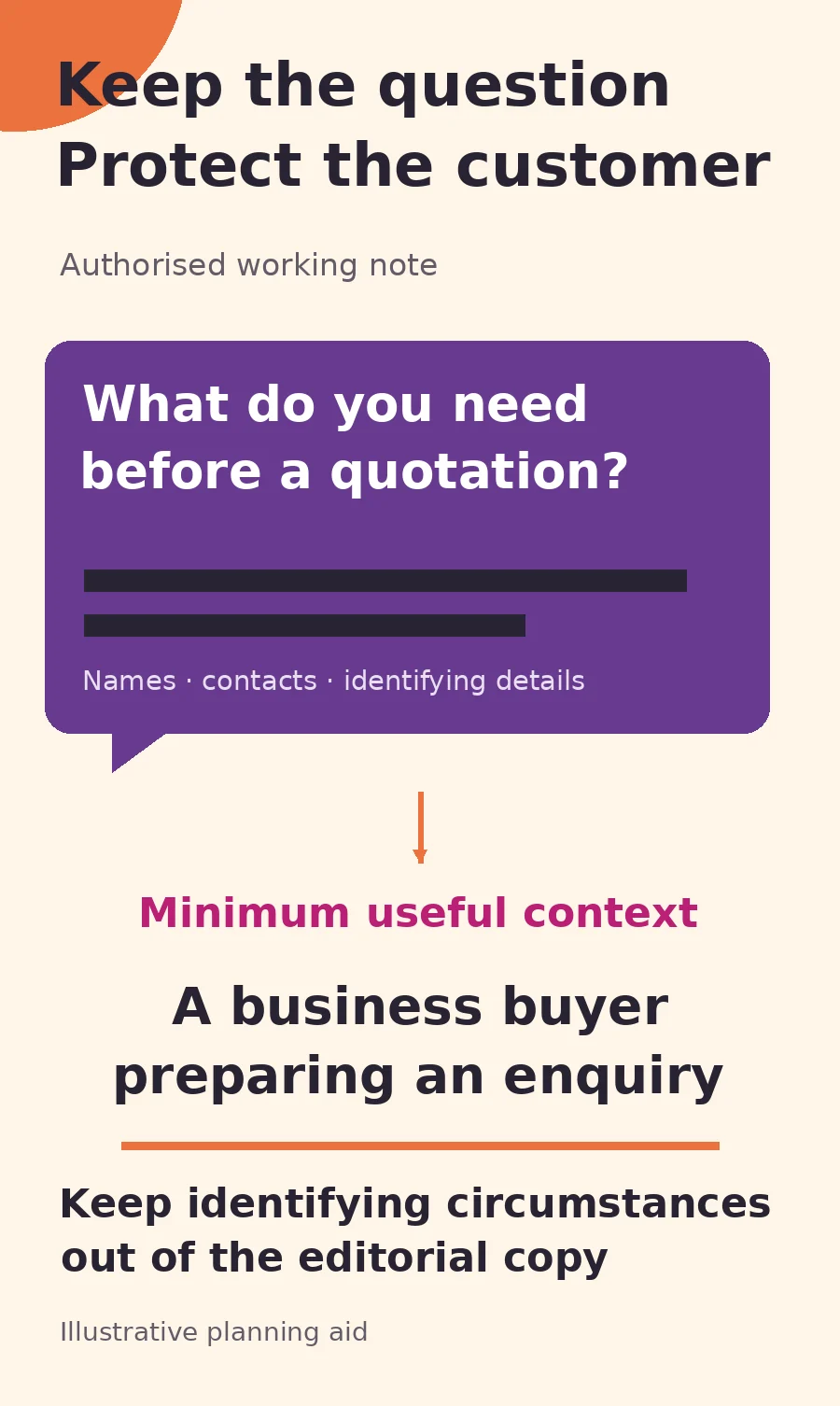
Remove names, contact details, account references and identifying project circumstances from the editorial copy. Replace them with the minimum context needed to understand the question. Do not paste private conversations, credentials or commercially sensitive attachments into writing tools. If anonymisation would still expose a customer or their project, keep the material out of the public-content workflow
Check whether the question belongs in search content
A good sales question can reveal a useful topic without proving that people search for it. Compare the wording with related searches and the pages currently appearing for the intended market and language. Look at what those pages help someone do: understand a problem, compare approaches, assess a provider or prepare an enquiry. Treat the results as evidence to interpret, not a template to copy
Where you have access, review Google Search Console queries alongside the pages receiving impressions and clicks, using a recorded date range and relevant filters. Its performance-report documentation explains that some queries are anonymised and the table does not show every query. A missing question therefore does not prove that demand is absent
If useful site data is unavailable, mark the topic as a research-led proposal. Do not invent a search volume, difficulty score or traffic forecast. You can still judge whether the question matters to the intended customer and whether the business has a reliable answer
Google’s people-first content guidance asks whether a site’s intended audience would find the material useful and leave able to achieve its goal. Use that as a relevance check: a fashionable topic outside your actual offer is a weak addition to the plan, even when it attracts attention
Group by the answer needed, then assign a page
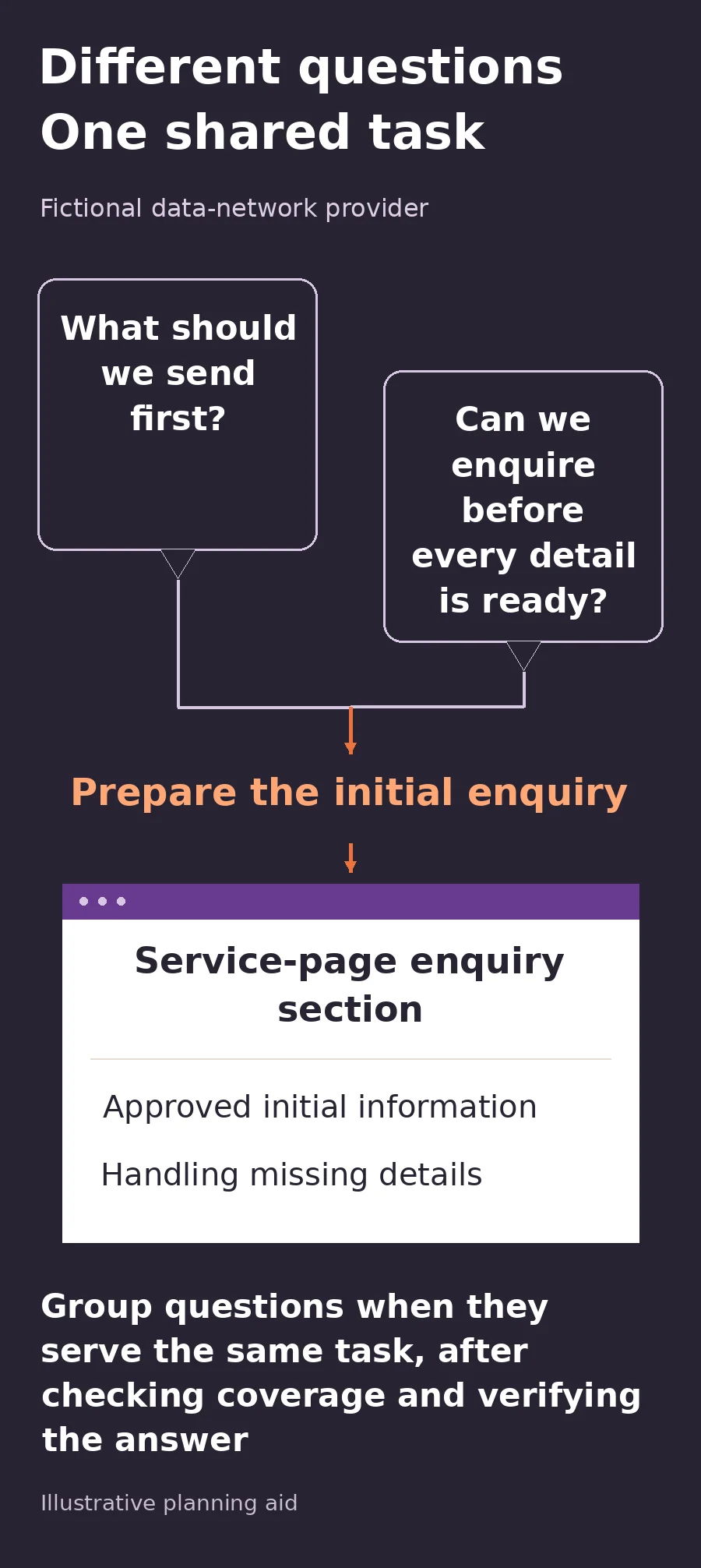
Group questions when they serve the same reader task and can be answered coherently together. Keep them separate when the decision, audience or evidence materially changes. Similar words are not enough to merge two needs, and different wording is not enough to justify separate pages
For example, “What do we send for a quote?” and “Can you assess the request before we have every detail?” may belong together in a service page’s enquiry section. A question about choosing between a new installation and upgrading what already exists may need a separate explanatory guide. It depends on the actual service and what the current site already covers
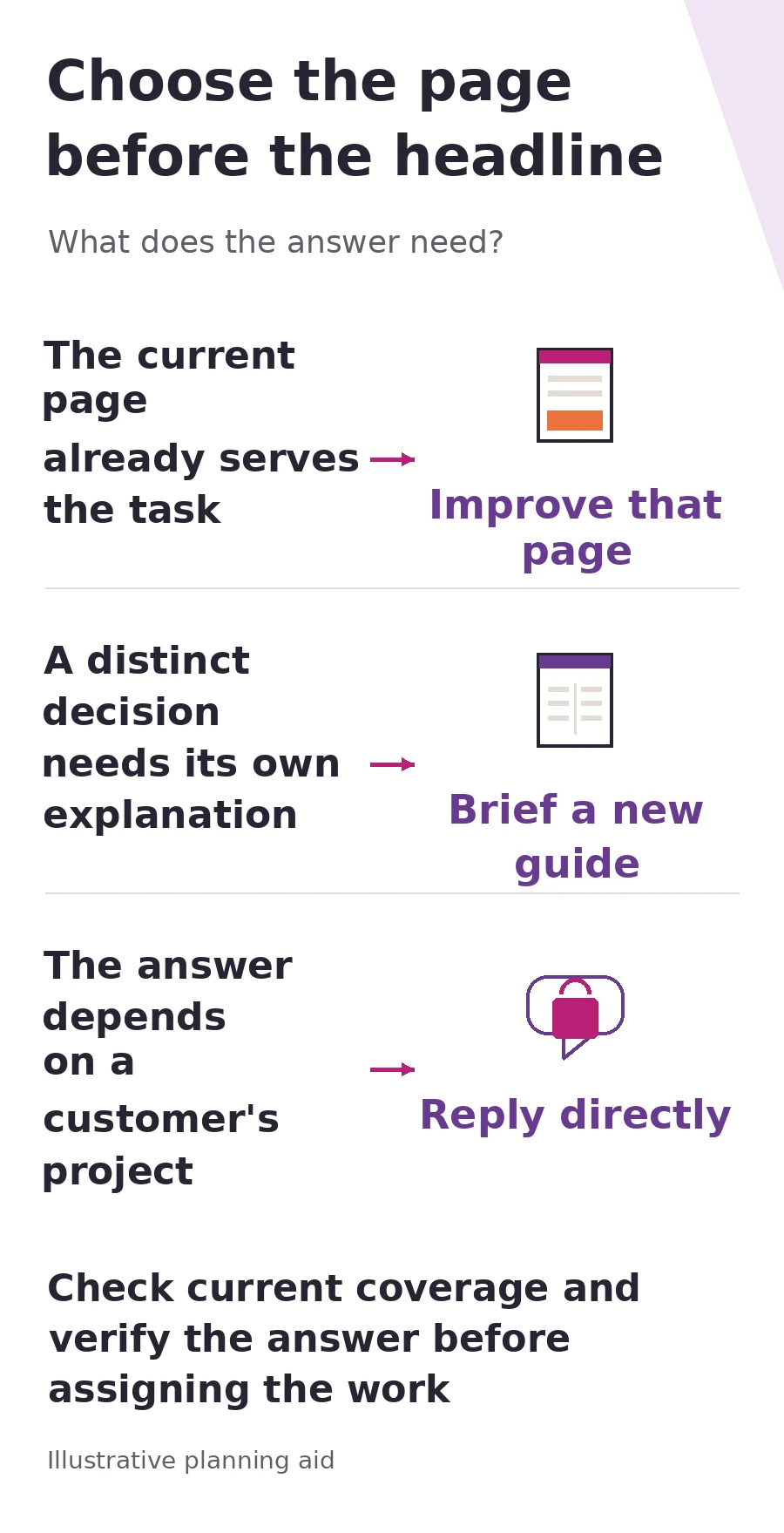
Improve an existing page when its job already fits
Read the page itself, not just its title. If the page already serves the task but its answer is missing, vague or hard to find, improve that section and its route to the next step. Keep a clear primary page in the plan for that task; related pages may mention it and link there where useful
Our service-page and blog-post guide explains the broader choice of page type. For buying questions about scope, suitability, evidence and quotations, the B2B service-page guide shows what the service page itself needs to make clear
Prepare a new page when the task needs its own explanation
A new article is justified when it answers a distinct, relevant decision that existing pages cannot cover well without losing their focus. State what the new guide adds, what it leaves to the service page and where the reader should go next. A change of keyword or a slightly different title is not sufficient justification
Keep a private answer when the facts depend on the project
Questions about a customer’s specific configuration, negotiated terms or confidential documents may need a direct response and assessment. Publish the general process or the information needed to begin, where useful, while leaving the individual answer with the responsible team. If the business cannot confirm a public claim, hold it for verification instead of turning uncertainty into confident copy
Worked example: separate a useful guide from a quotation detail
Fictional planning example: a provider of data-network services for business premises is reviewing questions received before quotation. The following are editorial decisions for illustration, not technical advice or claims about a real provider’s capabilities
“What information should we send first?” The buyer wants to start an enquiry. Assign the answer to the existing service page: approved initial information, what happens after submission and how unknown details are handled. The quotation owner confirms the process before the section is improved
“Should we extend the existing network or replace it?” The buyer is comparing approaches. Propose a separate guide only after checking existing coverage and search results. It could explain the questions an assessment needs to resolve and the limits of a general answer. A delivery specialist must verify it, and the article must not diagnose a particular installation from a website visit
“Will our particular equipment work with the proposed change?” The answer depends on the equipment and conditions. Route the individual request to assessment. The public page may explain the approved assessment process, but it should not promise compatibility before the necessary review
These questions produce one service-page improvement, one proposed guide and one private assessment route. That is a clearer plan than publishing three overlapping articles. The split is a judgement about this fictional situation, not a universal rule that every business needs this mix
Choose the next task using relevance, evidence and readiness
Prioritise questions connected to services the business actually provides and decisions it can help buyers make. Ask whether a gap is leaving an important existing page incomplete, whether the proposed answer adds something useful and whether the facts can be checked now
Separate work ready to brief from work waiting for evidence or a business decision. An article held because nobody has confirmed its central claim is not ready merely because a writer is available. Likewise, a short correction to an important service page can be the next useful action even when the calendar has room for a long article
Use observed repeat questions and genuine search data where available, with their limits recorded. Do not let the loudest recent enquiry or an unverified keyword estimate determine the whole queue. The result should be a manageable sequence of useful changes, each with a reason, an owner and a review point
Make each approved topic a brief someone can deliver
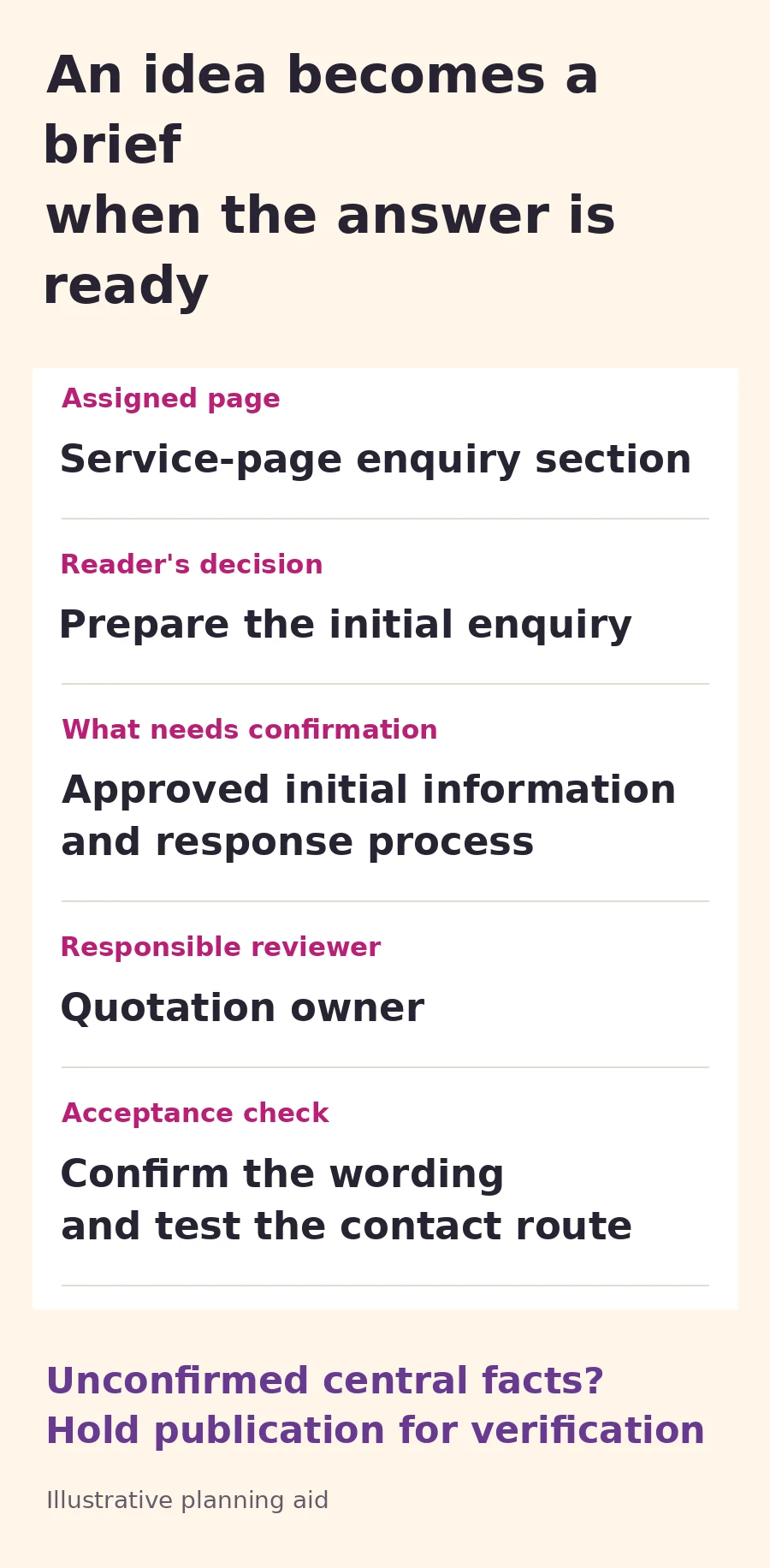
For every selected task, record the reader’s question and intended decision, the assigned page and language, whether the work is an update or new page, and what the existing content already answers. Add the approved facts, evidence still needed, responsible reviewer, next-step link and acceptance checks
In the fictional quotation example, the brief would name the service-page enquiry section, list the initial information the provider has approved, identify who checks the wording and require a test of the contact route. In the proposed comparison guide, the brief would instead define its decision boundaries and require the relevant delivery review
Plan useful illustrations at this stage. An annotated page can show where an answer belongs; a comparison can explain different choices. Keep the essential answer in readable HTML. Decorative diagrams and unsupported performance figures do not make an unfinished explanation stronger
For Arabic and English, check the terminology and actual search context separately, while keeping the meaning, evidence and service boundaries equivalent. Connect supporting articles to the appropriate service or next guide with descriptive links. Google’s link guidance recommends relevant contextual internal links; there is no ideal quota that every page must reach
Review the page’s contribution after it is published
Record what changed, when it went live and what you expect the page to help the reader do. Verify the published answer, images, internal links and enquiry action on a phone. A saved draft or an indexed URL does not establish that the useful journey works
Review relevant queries and page performance alongside the enquiries the team actually receives. Where consent, measurement and records permit, ask whether those enquiries fit the intended service and whether the same misunderstanding still needs explanation. A click or a contact-button event alone does not establish a qualified enquiry or a sale
Agree the review timing around the site’s available evidence and the question being tested; there is no universal waiting period or guaranteed ranking outcome. Distinguish observations from explanations. If useful enquiries change, other site, campaign, seasonal or sales factors may also have contributed
Start with one group of questions and the pages already on your site. Confirm the answers with the business, choose the next justified task and keep the decision record current. If you need help connecting research, page improvements and editorial production, explore ADAMS SEO services or tell us what your content needs to help customers decide