

When an advertising account has little reliable history, a forecast cannot replace a test plan. Before paying for traffic, decide what you need to find out, what the business can approve spending, and which evidence would support the next decision
An advertising test plan should make uncertainty manageable. It can help a team discover whether the enquiry route works and whether requests concern the intended service. It cannot promise a profitable campaign or turn a small set of responses into proof that one approach caused a better result
Main image: a conceptual illustration of examining a digital advertising idea, not a client campaign, a platform interface or evidence of results
Start with the decision, then write a testable expectation
Replace “see if ads work” with a question the team can investigate. For example: do received enquiries concern the service and area that the business intends to promote? Agree who will review those enquiries and what would make the answer useful
A testable expectation connects a proposed change to that question: “Explaining the service boundary more clearly may help people assess suitability before contacting us”. This is a hypothesis to examine, not a fact to put in the campaign report. If you have not yet chosen a suitable acquisition channel, first review the SEO or paid advertising decision guide
Google’s experiments guidance recommends a clear hypothesis, selecting success metrics before testing and changing one variable at a time. Use that discipline when defining a comparison, rather than changing the audience, offer, page and bidding approach together and then attributing the outcome to a new headline
Distinguish a limited pilot from a controlled comparison
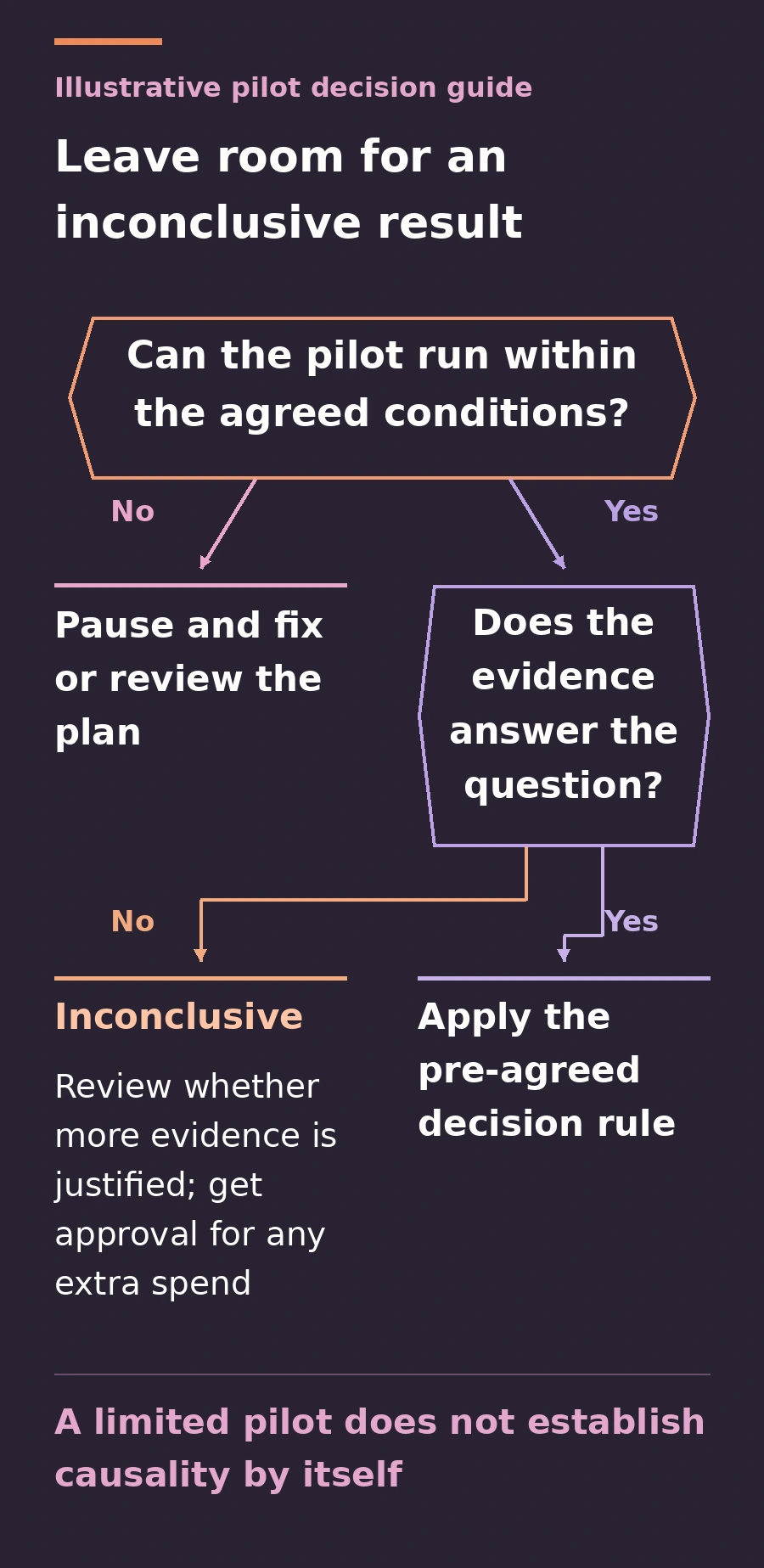
A limited pilot is an initial operational run with an agreed boundary. It may reveal a broken contact route, missing enquiry records or requests outside the service scope. Those observations can justify a specific correction without establishing which advertising variation performs better
A randomised comparison asks a different question. The NIST explanation of completely randomised designs describes random assignment to experimental conditions. Two ads receiving delivery through ordinary campaign optimisation are not automatically a randomised experiment, and comparing one week with a later week does not isolate the effect of a change
Choose the method that fits the decision and available evidence. A properly designed comparison needs a suitable allocation method and enough data for its intended analysis. If resources cannot support that, run a bounded pilot with a narrower question and describe its conclusions accordingly
Define a useful outcome and check the route before launch
Agree what counts as a relevant enquiry, who applies that definition and how duplicates, unrelated requests and unresolved cases are recorded. For a service company, relevance may depend on the requested work and service area. A suitable enquiry is still not a sale, and an unresolved case should remain unresolved rather than being counted as suitable
Check the actual mobile journey with an authorised, clearly labelled test request: advertisement destination, contact action, receipt and assignment to a responsible person. Verify what any conversion event records. Opening a messaging window is different from receiving a message, and a recorded form action still needs a working delivery route
If that route fails, fix and retest it before interpreting campaign quality. The website enquiry-journey guide covers that wider diagnosis. Keep only the necessary information in permitted enquiry records and avoid copying private customer details into a shared test document
Approve spending boundaries and stop conditions
Agree a total amount the business authorises for this test, the review responsibility and the conditions for pausing. Treat media spend, agency work and any production or third-party costs as separate items requiring their own approval. No universal starting budget can be inferred from an account that has no reliable baseline
Translate the business boundary into the controls available for the actual campaign type, then monitor spend. Google explains that an average daily budget can be exceeded on some days. Do not assume that entering a daily amount creates the same control as the business’s approved total test limit
Name the person who can pause the campaign and define practical triggers, such as a verified measurement fault, a misleading offer, an unavailable response team or the agreed spending boundary. If a result remains inconclusive, further spending requires a fresh decision; it is not automatically justified by calling the campaign a learning exercise
Put the plan in a record the team can use
Use a short shared record with an owner for each unresolved item. The format below is a planning aid, not a platform setup or a statistical calculation
| Decision to record | What to agree | Why it matters |
|---|---|---|
| Question and method | The business question and whether this is a pilot or a randomised comparison | Sets the limits of the conclusion |
| Audience and offer | Approved service, area, destination and the change being examined | Keeps the question focused |
| Evidence and quality | Event definitions, received enquiries, relevance criteria and reviewer | Separates activity from useful outcomes |
| Boundary and ownership | Authorised spending, pause conditions and the person responsible | Makes the test accountable |
| Review and next decision | Review point, reporting delays and the basis for stopping or continuing | Prevents an automatic extension |
Use the marketing brief template to resolve wider questions about the offer or approvals before turning this record into a launch instruction. Keep the original plan and log material changes instead of rewriting the starting expectation to match the eventual outcome
A hypothetical office-cleaning company
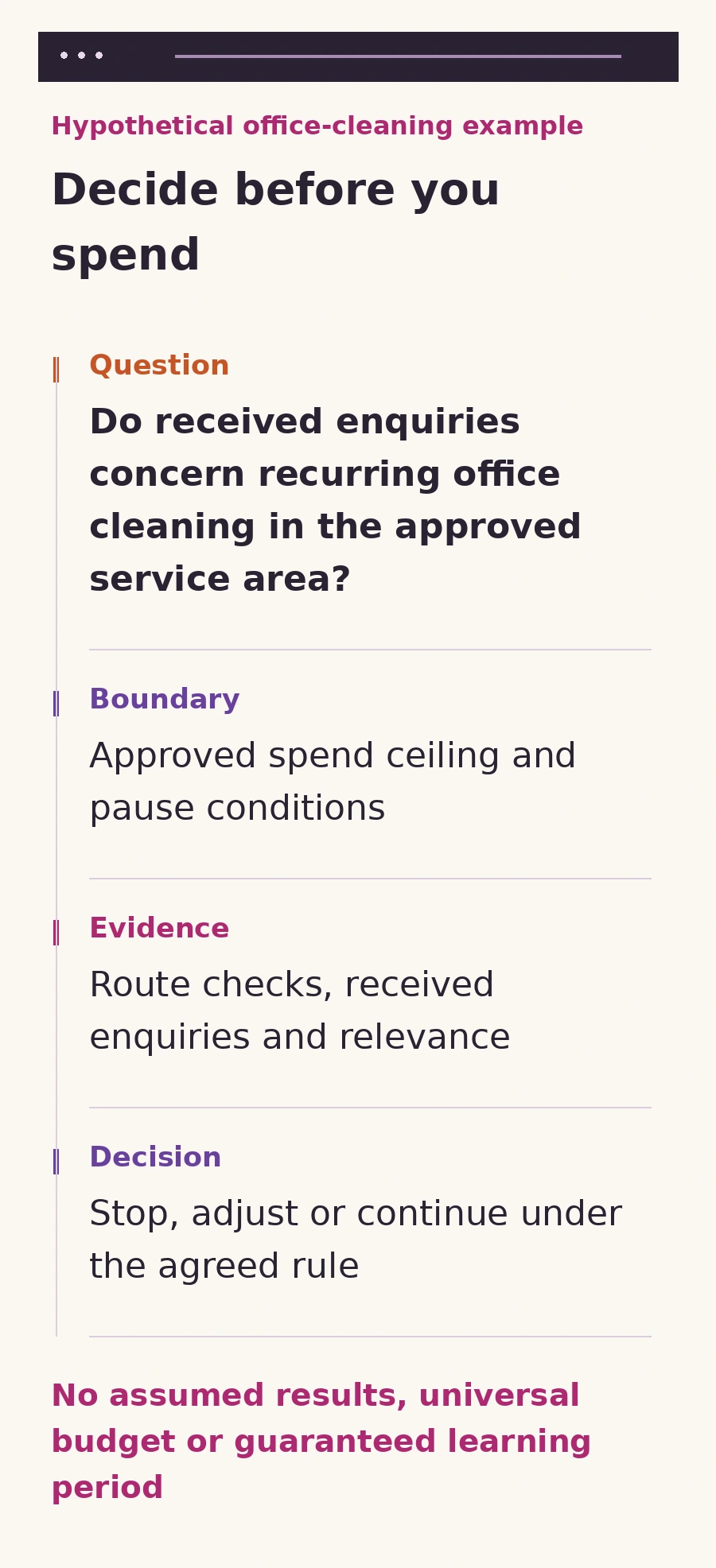
Consider a fictional company exploring search advertising for recurring office cleaning within its approved service area. The example has no assumed budget, response volume or campaign result, and does not describe an ADAMS client
Choose a narrow pilot question
The company asks whether received enquiries concern recurring office cleaning in the area it serves. It approves accurate service wording and exclusions, uses a destination that explains the offer, and assigns a person to review incoming requests. This is an operational pilot, not a comparison claiming that one message is a winner
Record what actually arrives
The reviewer distinguishes relevant office enquiries from requests for services the company does not provide, records unresolved cases and checks that requests reach the team. If there is confusion about the service, that is a reason to investigate the wording and delivery context, not proof that the entire channel is unsuitable
Make the next decision explicit
A verified contact fault leads to a pause and repair. Relevant requests with reliable records may support a proposal for a further bounded test, subject to approval. Too little usable evidence leaves the question open; the example assumes no improvement, sales or proven advertising effect
Review the available evidence without forcing a winner
Set a review point that reflects the question, customer decision process, reporting delays and approved boundary. Google’s conversion-delay guidance explains why recent performance can look weaker while later conversions have not yet arrived. Allow for that possibility without extending spend beyond authorisation
For a formal comparison, review its uncertainty and limitations as well as the headline metric. Google’s experiment reporting guidance recognises that a clear winner may not be determined. Low traffic or insufficient evidence does not establish that the alternatives perform equally. A finding of no practically meaningful difference can still inform a decision when the design, data and uncertainty support that conclusion
Separate what you observed, what remains unknown and the action you recommend. A reproducible operational fault can justify a repair; a cautious commercial decision may still be made under uncertainty, but it should not be presented as proof of causation. If you need help designing the question and launch checks, explore ADAMS paid advertising services or send us the decision you need the test to support