

A busy social account can be doing a useful job without producing an immediate sales conversation. The problem starts when likes, views or comments are presented as evidence that suitable enquiries are arriving, while nobody has checked what happens between the post and the person who answers
If you have social media engagement but no enquiries, review that connection before commissioning more posts. Start with the intended audience, follow the promise into the profile and contact route, then examine the conversations actually received. The aim is to locate a supported improvement, not to turn every follower into a buyer
Main image: a conceptual illustration of social content connected to a conversation, not a client account, real platform interface or evidence of results
Define the conversation your business needs
Write a working definition with the person who handles enquiries. For a service business, a useful conversation might establish a relevant need, a suitable location and a realistic next step. A compliment, a job application and a request for an unrelated service should not automatically enter the same category as a suitable new-business enquiry
This does not make educational or community content worthless. A post can answer a question or help someone recognise your business before they are ready to contact you. Judge it against its intended role, while keeping a separate record of enquiries and their outcomes
Read the definition behind each platform metric. For example, LinkedIn’s Page content analytics guidance distinguishes reach, clicks and interactions; its clicks can include the content, company name or logo. That is a reason to check what a report counts, rather than assuming every click is a website visit or a lead
Follow the handoff and record what you can observe
Choose a published post intended to support an enquiry. Open it on a phone as a visitor, read the profile, follow the stated contact route and send a clearly labelled test enquiry through a channel the team has agreed to test. Confirm that it reaches the responsible person; a button opening a conversation window does not confirm that a message was sent or received
Use authorised account reports and enquiry records to compare the same period. Separate paid distribution from unpaid activity where the reporting allows it, record the date and metric definitions, and note missing information. These observations help you ask better questions; they do not by themselves prove why someone stopped
| Observation | What to check | Possible next action |
|---|---|---|
| Reactions, but few relevant questions | Whether the topic speaks to a need the service can meet | Clarify the audience and the practical question answered |
| Profile visits and repeated basic questions | Whether service, location and next step are easy to find | Make essential profile information clearer |
| Contact interactions, but no matching received requests | Whether the route works and receipt is being recorded | Fix a verified delivery or recording fault |
| Suitable messages without an agreed next step | Who replies, what they need and how follow-up is assigned | Clarify ownership and the first reply |
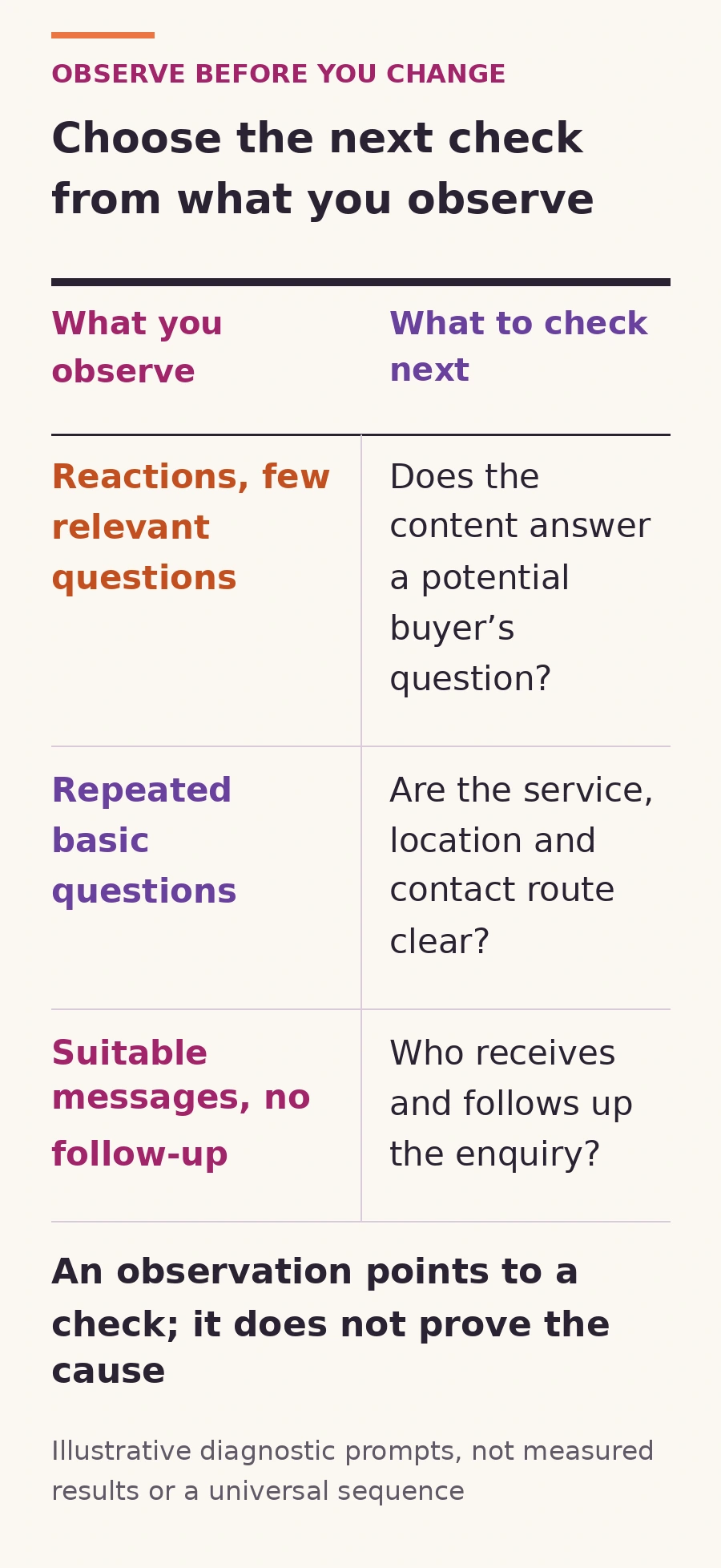
The table offers checks, not diagnoses. If the website is where the route breaks, use the fuller website enquiry-journey guide rather than treating every failure as a social-content problem
Check relevance before increasing publishing volume
Look at the questions and situations your content attracts. Are people asking about work you actually provide, in markets you serve? A visually popular topic may attract peers, casual viewers or existing customers. Those audiences can have value, but their reactions do not establish demand for the service you want to sell
Compare the intended reader with the problem the post answers. “A meeting room that looks impressive” and “a space suitable for a company workshop” give a venue different content tasks. Explain the approved facts that help the organiser assess fit, without implying facilities or availability the venue has not confirmed
When the topics themselves need rebuilding, use a content plan based on customer questions. Here, keep the review focused on whether the current post and its next step belong together
Keep the promise clear from post to profile
Someone arriving from a specific post should be able to recognise the same service in the profile and linked destination. Check the business description, service area, current contact details and the action you are asking them to take. Remove conflicting instructions and outdated offers before adding another call to action
Nielsen Norman Group’s guidance on recognition and recall explains why visible information and contextual cues help people use an interface. Applied here, that means naming the relevant service and next step clearly, rather than expecting a visitor to remember details from an earlier post. This is a design principle, not a forecast of enquiry growth
Choose the next step to match what the team can do: ask about suitability, check availability or request a scoped discussion. Explain what information is needed initially and what follows. Do not promise an instant quotation or a response deadline unless the business has approved and can deliver it
Review the first reply as part of the content journey
Read a permitted sample of relevant conversations after removing personal details. Does the first reply address the question, ask only what is needed and explain the next step? A generic greeting or an immediate request for a long brief may leave the person without an answer to the need that brought them there
Agree who handles public comments, private enquiries and follow-up, and how an unanswered request is noticed. Keep sensitive details out of public comments, and request confidential material only when necessary through an agreed channel. An automated acknowledgement can explain that a request was received; it should not be recorded as a completed human response or a qualified enquiry
If nobody owns those tasks, clarify them in the scope of social media management. Publishing, community replies and sales follow-up are different responsibilities and should be allocated explicitly
A hypothetical meeting venue: change the connection
Consider a fictional meeting venue in New Cairo. Its attractive room photographs receive general praise, while organisers repeatedly ask where it is and whether it hosts company meetings. This is an illustrative situation, not a client case or a measured result
Make the service recognisable
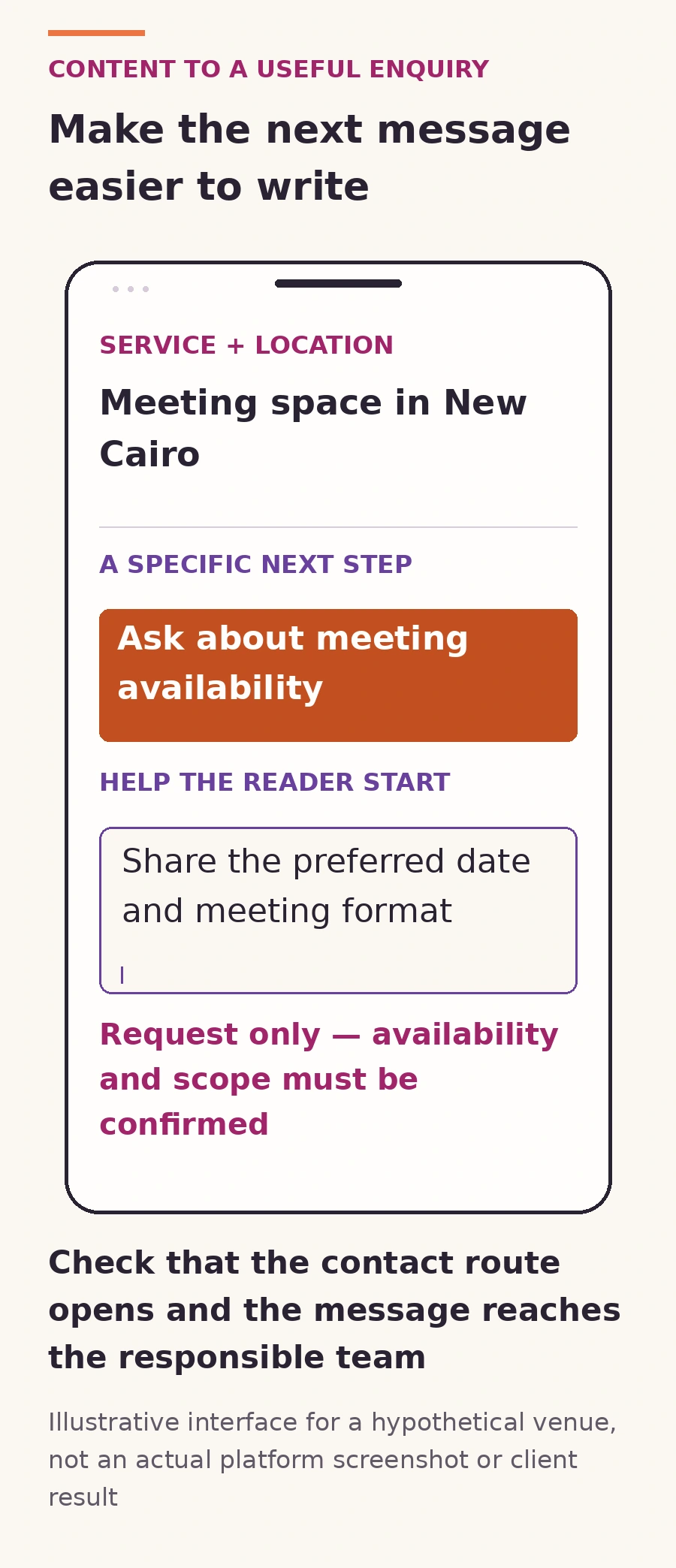
Replace a vague profile description such as “events and experiences” with an accurate description of the actual offer, such as “meeting space in New Cairo”, if that matches the venue. Show only confirmed facilities and use content that answers an organiser’s practical question, rather than relying on the photograph to communicate suitability
Ask for a useful first message
A possible invitation is “Ask about meeting availability”, followed by “Share the preferred date and meeting format”. These are proposed copy examples, not a booking system or a promise of availability. The venue would acknowledge receipt, confirm availability and applicable scope, and request any remaining information before making an offer
Review what changes in the conversations
Check whether received enquiries refer to the intended service and contain information the team can use. Record continued confusion as well as relevant requests. More messages alone would not establish an improvement, and no improvement is assumed in this example
Test a supported change and review its limits
Start with a fault you can demonstrate or a clear question to test. Record the original wording, proposed change, owner and review period before implementation. Avoid changing content, audience, offer and reply process together if you need to understand which change may have helped
Where social links lead to your website, Google’s campaign URL guidance explains how UTM parameters identify referring campaigns in Analytics. Consistent tagging can help distinguish traffic sources; it does not establish that a visitor sent a private message, sent a relevant enquiry or bought. Use no personal information in link parameters, and match permitted enquiry records separately
Review received enquiries, their relevance and agreed next steps alongside content activity, noting changes in distribution, seasonality, offer or team coverage. Sparse data may leave the result inconclusive. A broken contact route can still be fixed when the fault is reproducible; a claim of commercial improvement needs appropriate evidence
If you need help connecting content, profile information and the agreed response process, explore ADAMS social media management, or send us the account and the decision you need to resolve. The next step is a clear review of the gap, rather than a promise that more posting will produce sales