

A useful marketing brief lets a writer, designer and the person approving the work understand the same task before production begins: who it is for, what it should help them do, which facts support the message and what still needs an answer
This guide includes a marketing brief template you can adapt for a launch or a defined piece of marketing work. It also shows how to keep unanswered questions visible, so a polished document does not make an unverified service promise look approved
The main image is a conceptual illustration created for this guide, not a client project, a finished campaign or evidence of results
Start with the business decision behind the request
“We need a campaign for the new service” describes an intention. Before choosing formats, explain what is being introduced, which customers need to understand it and what you want them to do next. A requested video or social post can stay among the options while the team checks whether it serves that task
The IPA, BetterBriefs and Mark Ritson guide to briefing an agency connects the brief to marketing strategy, audience, objectives and supporting evidence. It also recommends agreeing how the work will be evaluated. Those principles help frame the task; the practical working template below is an ADAMS editorial example, rather than a reproduction of the guide
If your team has not decided which market to serve or why customers should choose the offer, record that as marketing strategy work to resolve first. Filling in a template cannot replace that decision or the research needed to support it
A marketing brief template you can actually complete
Use a shared digital document with an owner, version and last-updated date. Keep the decisions readable, with supporting research and files linked separately. Adapt the detail to the task; there is no required page count
| Brief field | What to record | A useful check |
|---|---|---|
| Context and task | What is changing, why the work is needed now and the decision already made about the offer | Can someone explain the task without naming a format? |
| Audience and next step | The customer group, its relevant situation or question, and the action the communication should support | What would make this action useful to both the customer and the business? |
| Message and evidence | The main point to communicate, the source supporting each material claim, and who can verify it | Which claims must stay out until evidence is approved? |
| Scope and constraints | The agreed work, languages, channels, exclusions, required dates and approved budget limits or their approval status | Which constraints are fixed, and which are preferences? |
| Inputs and dependencies | Required service details, brand files, permitted images, permissions and responsible owners | What can proceed now, and what depends on a missing input? |
| Review and approval | Specialist checks, a feedback coordinator, the authorised approver and criteria for accepting the work | Who can approve content facts, creative work and release? |
| Evaluation and open questions | How outcomes will be assessed, available baseline data, and unresolved questions with owners and dates | Are a target and a measurement method approved, or still to be agreed? |
Write “not yet approved” where necessary. Do not insert a made-up budget, target or baseline simply to complete a field. If the brief records a budget limit, make clear whether it covers production, paid media or both, and who approved it
A brief records working direction. Scope, fees, usage rights and other commercial terms still need the appropriate agreement; this template does not replace a contract, rights clearance or legal advice. For ongoing social work, use the separate guide to social media retainer scope to examine what belongs in that agreement
Keep confirmed information separate from assumptions
A confident sentence can hide a missing decision. Mark each unresolved item with its status, the person responsible for answering it and the date needed for the affected work. An assumption may help explore an idea internally, but it must not become a public fact without verification
- Confirmed: an authorised owner has checked the information, and the brief links to the current source
- Working assumption: a provisional basis for discussion, clearly labelled and not approved for publication
- Open question: an answer is missing; name its owner, due date and the work that depends on it
For example, a service-area question might not prevent an internal layout exploration, but it can prevent final copy and campaign targeting from being approved. Agree that boundary explicitly. If the audience or offer itself is unresolved, production may need to wait until the direction is clear
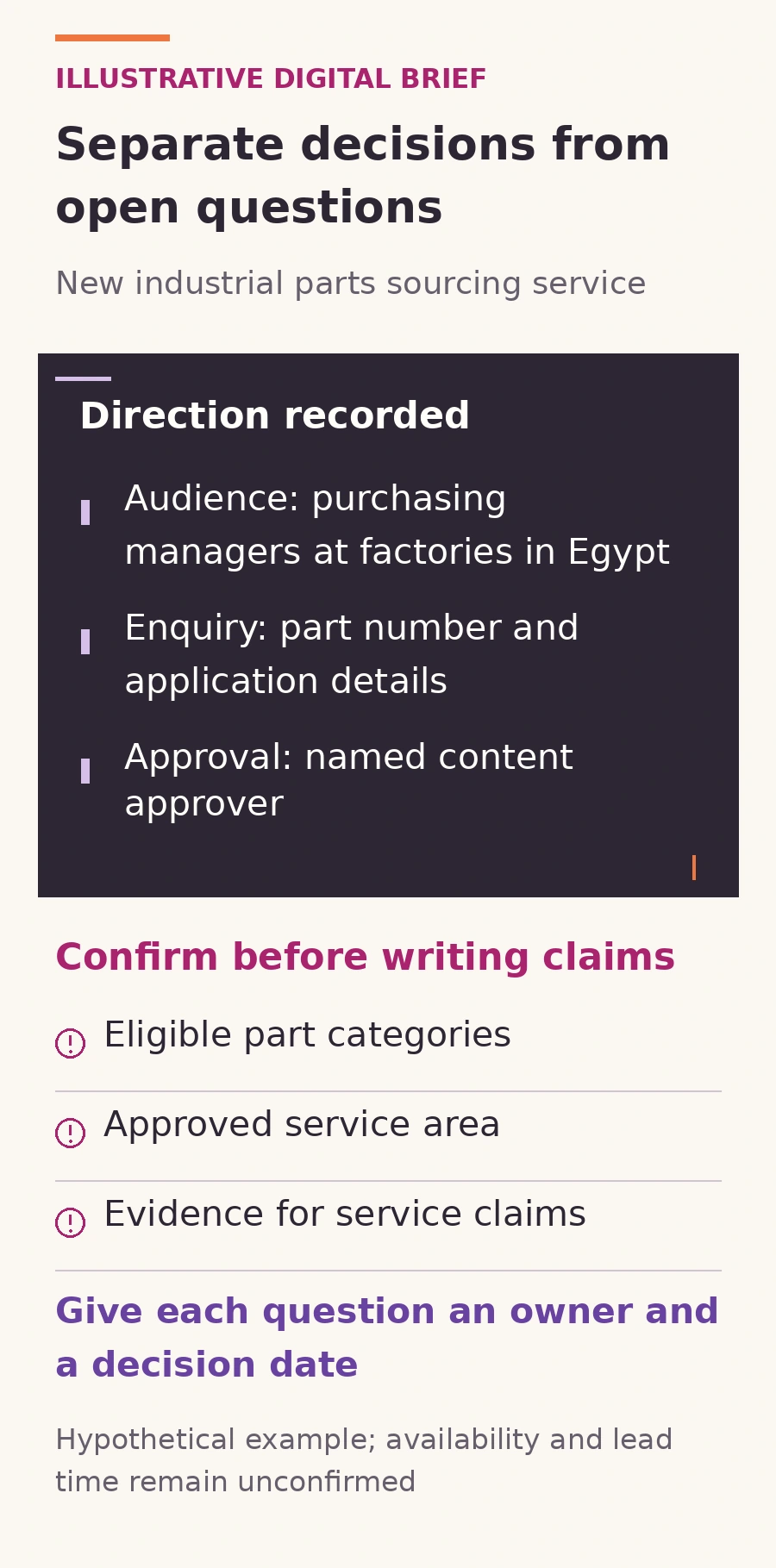
Worked example: launching an industrial parts sourcing service
Hypothetical example: the following company and launch are invented to demonstrate the brief. They are not an ADAMS client case study, a service offer or a claim about market demand
The starting request is: “Make a campaign for our new parts sourcing service”. A usable draft gives the team something more specific to discuss:
- Task and audience
- Introduce the service to purchasing managers at factories in Egypt who need to ask about a specified industrial part
- Intended next step
- Ask the purchasing manager to send the part number and application details so the operational team can assess the request. An enquiry is not confirmation of stock, compatibility or delivery
- Message boundary
- Explain the verified process for submitting an enquiry. Do not promise universal availability, a delivery time or suitability for a particular machine
- Evidence and missing inputs
- The operational owner must confirm eligible part categories, approved service areas and the information required to assess an enquiry. Link to the approved service description and permitted product imagery when available
- Approval and release
- The operational owner checks service facts; the authorised marketing approver checks the final communication. Release waits for both checks and any required permissions. Set the actual owners and dates before accepting the brief
This is still a draft until those missing inputs are resolved. It guides the discussion without inventing the answer. It also leaves the creative team room to propose how to explain the service, within the agreed channel and production constraints
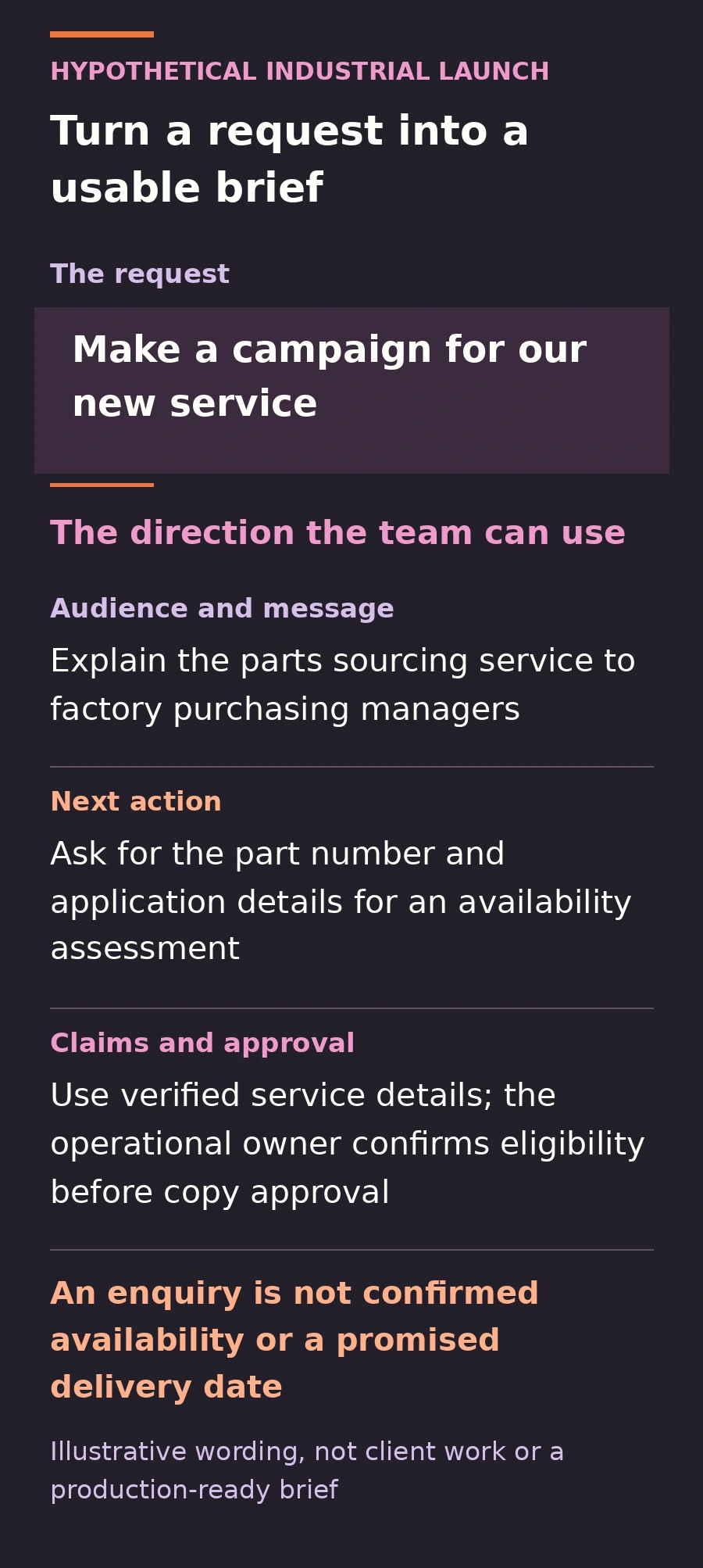
Make claims and inputs easy to check
Place evidence beside the statement it supports, rather than in an unlabelled folder. Record the exact claim, its source, its date or version, the person checking it and the wording approved for use. A source about one product model does not automatically support the same statement about every model
In the hypothetical launch, “send a part number for assessment” is a different proposition from “we supply every part immediately”. The latter must not slip into a headline simply because it sounds stronger. If evidence is unavailable, remove the claim or hold the affected copy for review
List the production inputs just as clearly: current brand assets, language requirements, service details, image permissions and any technical restrictions. Record what can be used and where. A file being available in a shared folder does not establish permission to publish it
Agree how work is reviewed and how changes are handled
Give specialist reviewers defined questions. An operational reviewer can check what the service actually includes; a language reviewer can check meaning and clarity; a brand reviewer can check visual consistency. Identify who brings their feedback together and who is authorised to approve the final work
Set acceptance criteria before reviewing creative work. For this hypothetical launch, the communication should identify the intended buyer, explain the enquiry process accurately, request the required details, avoid unverified availability claims and meet the agreed language and format requirements. Passing these checks means the work meets the agreed brief; it does not guarantee enquiries or sales
Separate a correction from a changed decision. Fixing a wrong part category against approved information is a correction. Adding a new customer group or changing the service being promoted changes the brief. Record the requested change, affected work, timing or budget implications and the authorised decision before updating the version
Delivery checks and marketing outcomes are also different. Decide what will count as a relevant enquiry, who will assess it and which data will be available after release. If no reliable baseline exists, say so and agree how learning will be recorded instead of presenting an invented improvement target
Discuss the brief before production starts
The IPA’s briefing best-practice guide distinguishes the written brief from the briefing discussion. Read the document with the people doing and approving the work, ask them to explain the task back in their own words, and resolve different interpretations before treating it as accepted
Finish with a clear next step: the current version, outstanding questions, the owners answering them and the decision that allows production to begin. A brief can improve shared understanding, but it cannot remove every revision or guarantee campaign performance
If the task is specifically a website project, continue with the website redesign brief guide rather than expanding this general template into a technical specification. To discuss your own marketing task with ADAMS, send your context, available inputs and open questions