

The hero is a conceptual illustration of digital content production and approvals, not ADAMS staff, a client project, performance data or a precise technical workflow
Two social media proposals can promise a similar amount of content while asking your business to do very different work. One may cover planning, writing, design and publishing; another may expect you to supply finished material and handle every enquiry
A useful monthly retainer makes those responsibilities visible before production starts. Compare the work, the inputs, the approval process and the boundaries together, rather than choosing from a post count alone
Start with the job your social accounts need to do
Write a short description of the audience, the offer and the useful next action. A consultancy explaining its expertise, a retailer presenting a product range and a hotel answering availability questions need different material and different support from their own teams
Then identify the recurring work you need help with: planning topics, producing usable content, adapting it for the agreed channels, publishing it, handling responses or reviewing what happened. A provider can cover some of that work or a broader programme, but the proposal should say which
Ask how the content will support the business decision you care about and how the team will review its contribution. Consistent production is a commitment you can define; a guaranteed number of sales is not an appropriate substitute for a clear scope
Agree what counts as a deliverable
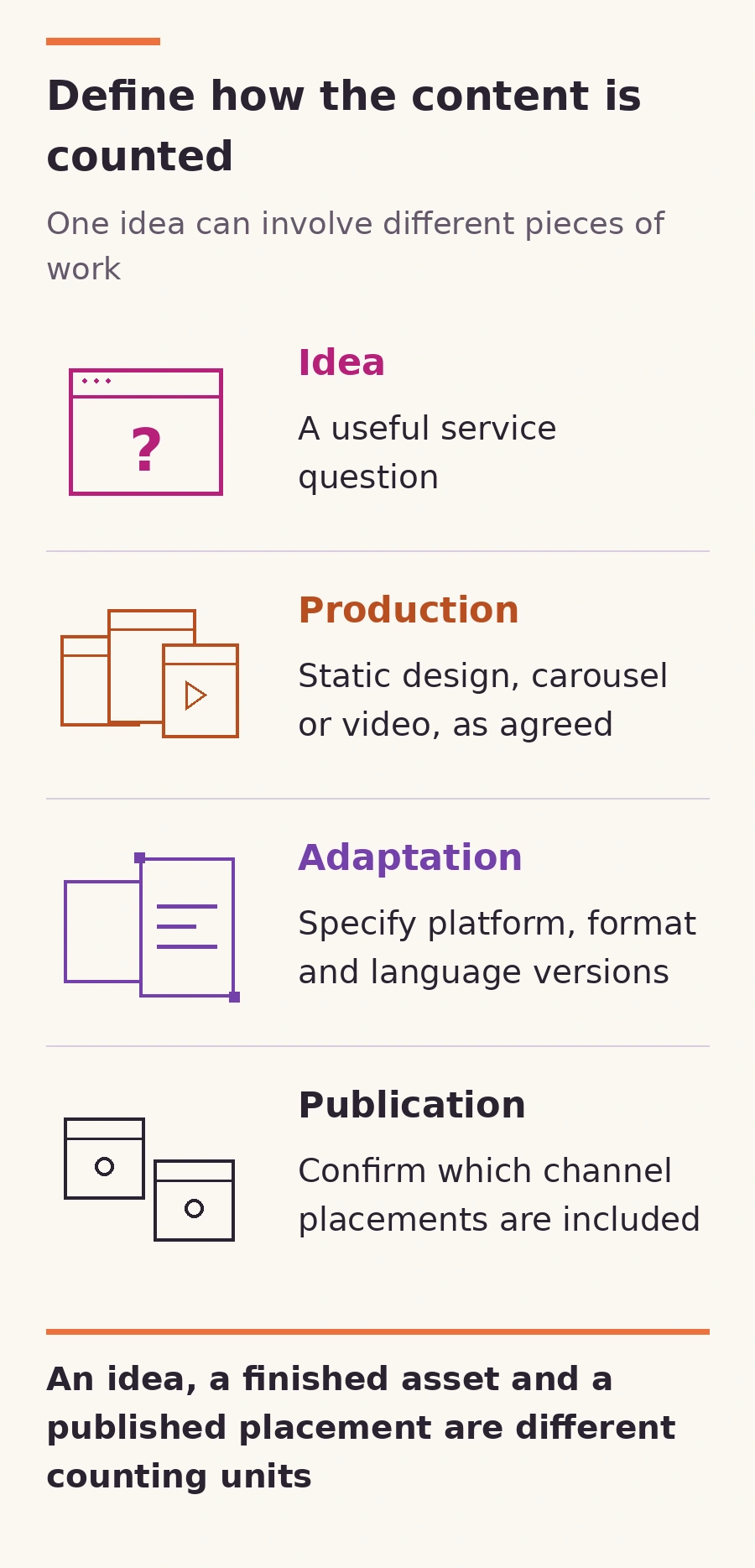
The word “post” can hide several different units of work. Separate these in the proposal
- Idea: the customer question or message the piece addresses
- Production: the copy, design, animation or edited video needed to communicate it
- Adaptation: changes for a platform, placement, format or language
- Publication: the approved version placed on the agreed account
Confirm whether quantities are totals across the named platforms or separate allowances for each. Define how carousel panels, story sequences, resized versions and cross-posted material are counted. Reusing a finished asset and producing a new version are different tasks; neither counting method should be assumed from the headline quantity
For video, specify the format, approximate duration, source material and editing requirements. For bilingual work, identify which pieces need both languages and who checks the meaning and final artwork. Translation and adaptation should not disappear inside an undefined “copywriting included” line
A hypothetical professional-service example
Imagine an engineering consultancy that wants to explain what a prospective client should bring to an introductory meeting. This is an illustrative scenario, not an ADAMS client result
The business provides the correct service information and material it is permitted to use. The agency might develop a carousel explaining the preparation, or edit a short video from suitable footage supplied by the business. Those are production choices, not interchangeable promises
If the business wants both, Arabic and English versions, publication on different accounts and replies to questions afterwards, each requirement needs to appear in the agreed scope. Supplying footage does not automatically include filming, and publishing the content does not automatically assign someone to answer the resulting enquiry
Make the inputs and production work visible
Ask what the agency needs from you and when: service facts, offers, availability, brand files, suitable photographs, footage or an authorised person to check technical claims. Name the person who supplies each input. “The client will provide content” is too vague to plan production around
Separate recording from editing. If filming is included, define its practical scope and responsibilities. If the agency edits supplied footage, agree what makes that footage usable and what happens if it is missing or unsuitable. Clarify voice-over, music, stock assets, usage permissions and any extra production before the content is scheduled
Accessibility also needs a production owner. Distinguish the text accompanying a post from captions synchronised with a video’s speech and relevant sounds, and from subtitles in another language. W3C’s captions guidance explains these differences and the need to check automatic captions for accuracy
Include the accessibility work appropriate to the agreed material, such as descriptive alternative text for images and reviewed video captions. W3C’s media-planning guidance recommends defining requirements and responsibilities early. A captioned video alone is not proof that every accessibility need has been met
Choose an approval route that people can use
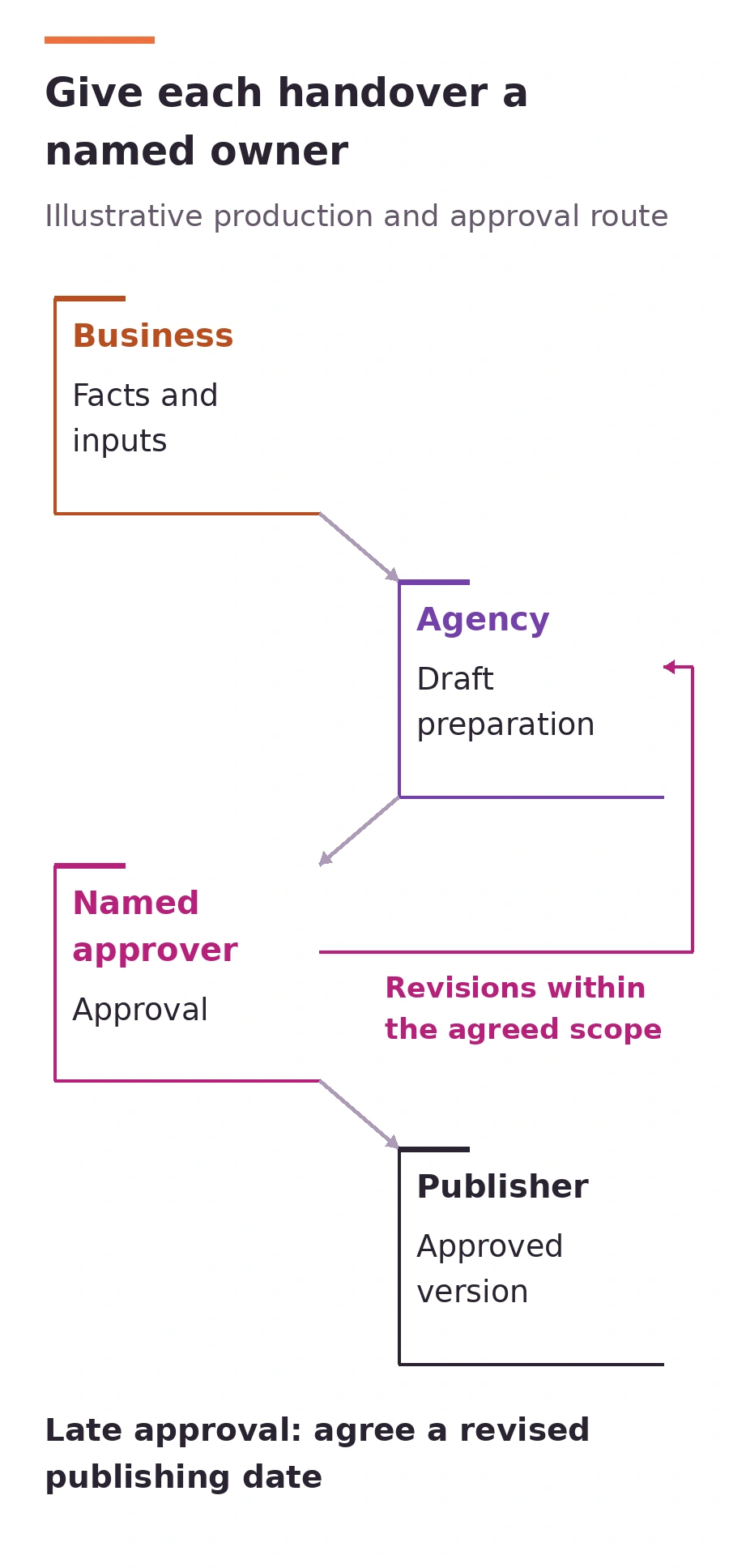
Name the person who can approve the content and the place where approval is recorded. Set review dates that fit the publishing plan, and agree what happens when an input or approval arrives late. Silence should not be treated as approval unless that process has been explicitly agreed
Define the revision allowance and what a revision covers. A correction within an agreed brief differs from replacing an approved offer, commissioning a new format or adding another language. Ask how errors, new requests and changes after approval will be handled, rather than leaving them under “reasonable amendments”
Collect feedback into one usable response from the business. Before scheduling, check that the approved version contains the correct claims, dates, links, contact details and language. If the approval changes, identify the replacement version and confirm the publishing decision again
Separate publishing from replies and enquiry handling
Publishing needs named accounts, agreed timing, an approval record and someone who checks whether the approved material actually appeared. Ask who deals with a failed publication or an urgent correction, and how the business will be notified
Replies to comments and direct messages are another responsibility. If they are included, define the channels, languages, coverage hours, response expectations, approved answers and the issues that must go to the business. Sensitive complaints, service availability and quotation decisions may need a named internal contact
Decide who receives a genuine enquiry and records the next step. A community reply can acknowledge a question without completing a sales conversation. If replies or sales follow-up are outside the retainer, assign them within the business before publishing begins
Use a scope worksheet to compare proposals
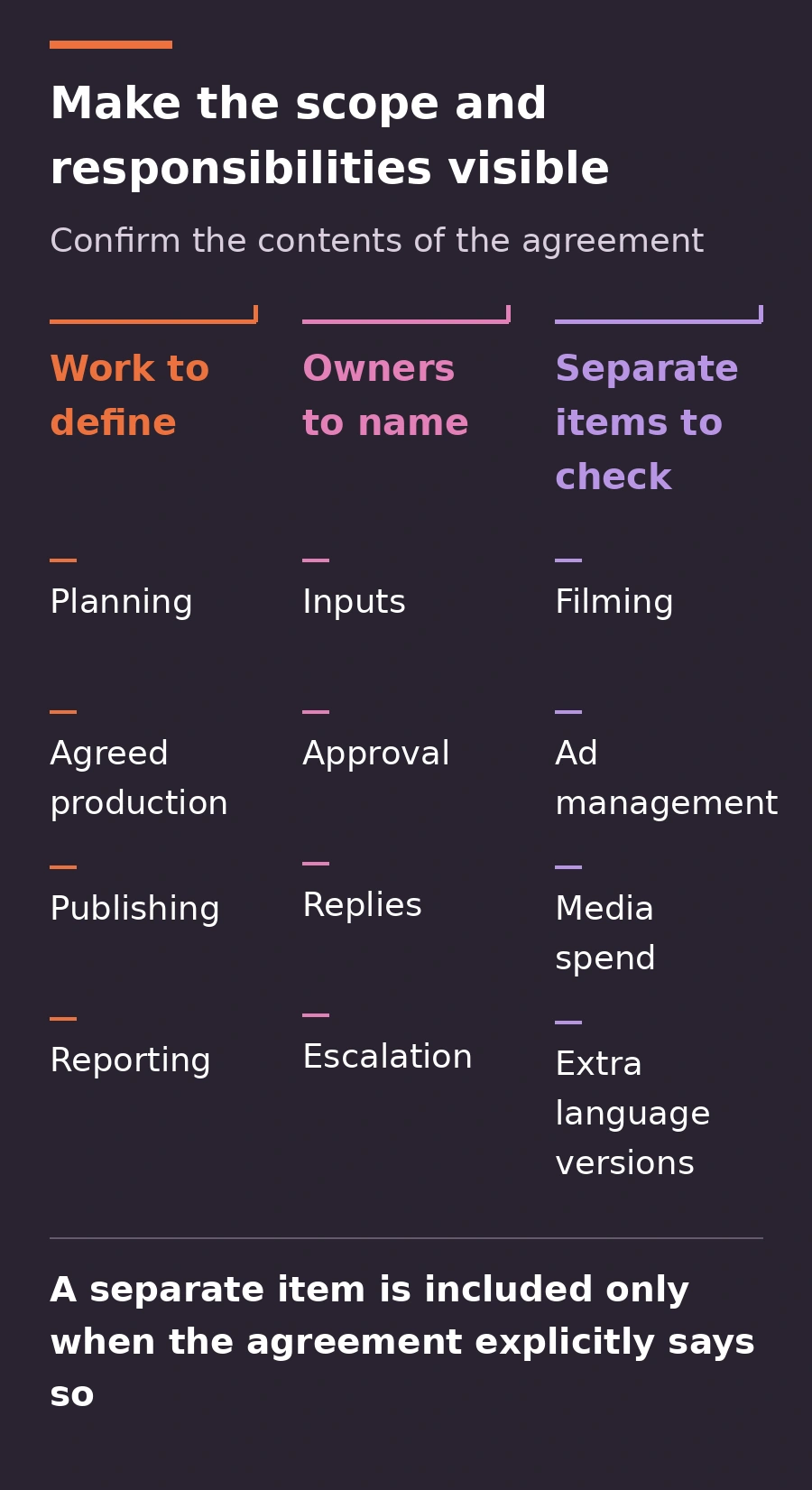
Ask each provider to complete the same comparison. These are areas to clarify, not a claim that every monthly package includes all of them. Replace broad labels with the actual deliverable, responsible person and record you will use to confirm completion
On a small screen, scroll the table horizontally to read all three columns
| Work area | What to clarify | What to record |
|---|---|---|
| Content units and channels | Formats, quantities, counting rules, accounts and language versions | Named outputs and an agreed content plan |
| Inputs and production | Who supplies facts and assets; who writes, designs, records, edits and checks accessibility | Input owner, required material and delivery date |
| Approval and changes | Approver, review dates, revision allowance and treatment of new requests | Approved version and consolidated feedback record |
| Publishing and replies | Publishing checks, response coverage, escalation and enquiry handoff | Named publisher, responder and business contact |
| Reporting and handover | Review questions, data access, usable files and the end-of-service process | Reporting responsibility and an agreed handover list |
A “not included” answer can still describe an appropriate arrangement if the work has a clear owner elsewhere. An unanswered line is the problem to resolve before comparing the proposals on price
Keep advertising spend and performance review clear
Ask for the agency’s service fee, any advertising-management work and the money intended for the advertising platform to be identified separately. If a proposal includes paid promotion, specify who sets up and monitors it, who approves the spend and which account and payment arrangement will be used. Creating an organic post does not, by itself, commission a managed advertising campaign
The report should connect the agreed work to a decision: what was published, what responses appeared, what evidence is available and what should change next. Separate unpaid and paid activity when comparing results, and distinguish a contact-link click from a received or suitable enquiry
Agree what information your business will provide from enquiry or sales records, and acknowledge gaps rather than presenting every interaction as a commercial result. Our guide to reading a useful digital marketing report explores that review in more detail
Plan account access and handover before the first post
Confirm who controls the business accounts and which people need access for the agreed tasks. Use the platform’s appropriate access options rather than sharing a personal login. Meta’s account-security guidance advises protecting login details and using two-factor authentication
Record who can maintain business access if a team member changes. Agree how access will be reviewed when the engagement ends, and how approved work, reports, scheduled material and outstanding enquiries will be handed over
Define which final files, editable files or source materials will be supplied, in which usable formats, and subject to which agreed permissions. Do not assume that every font, music track, stock asset or production file can be transferred or reused without checking the relevant terms
Agree the working arrangement before you choose the package
Before committing, ask the provider to walk you through the first production cycle: what they will prepare, what you must supply, who approves it, who publishes it and who handles responses. You should be able to explain the arrangement to the person inside your business who will make it work
When the scope is clear, compare it with the work your accounts actually need and the support your team can provide. More content can add production capacity; it does not remove the need for accurate inputs, useful creative work or a functioning response process
ADAMS can discuss the appropriate social media management scope around your audience, channels and available material. Send your account links, main business objective and any responsibilities you already cover internally, then talk to us about the work you need