

The hero is a conceptual illustration of a campaign and its website destinations, not client work, performance data or a precise technical diagram
Your campaign makes a promise before anyone reaches your website. If the page opens with a different subject, a long list of services or an unclear next step, the visitor has to work out the connection
The homepage versus landing page decision starts with that connection. Choose the page that explains the advertised offer to the intended audience and supports the next action. Sometimes that is your homepage, sometimes an existing service page, and sometimes a dedicated campaign page
Understand what you are actually comparing
In Google Ads terminology, a landing page is simply the page someone reaches after clicking an ad. A homepage or service page can therefore be a landing page. Here, “dedicated landing page” means a page deliberately prepared around a particular campaign, offer or audience
A homepage usually introduces the business and helps people choose where to go. A dedicated campaign page can give a narrower offer more space and a more direct path to an enquiry. Neither label proves that a page is relevant, useful or ready to receive visitors
Write the promise, audience and next action first
Before asking for a new design, complete a short campaign brief that a writer, designer and campaign manager can all use
- Promise
- What will a person reasonably expect to find after seeing this particular ad or message?
- Audience
- Who is it for, what do they already understand, and what must they check before taking the next step?
- Next action
- Should they explore the business, check suitability, request availability, discuss a requirement or complete another clearly defined task?
Then open each possible destination on a phone. Read the ad and the first useful content together. Can you identify the same offer, the relevant audience and what happens next without searching through unrelated sections?
Google’s landing-page guidance recommends matching the destination to the ad and its call to action. The practical decision is how well a page fulfils that expectation, rather than whether it has been given a particular marketing label
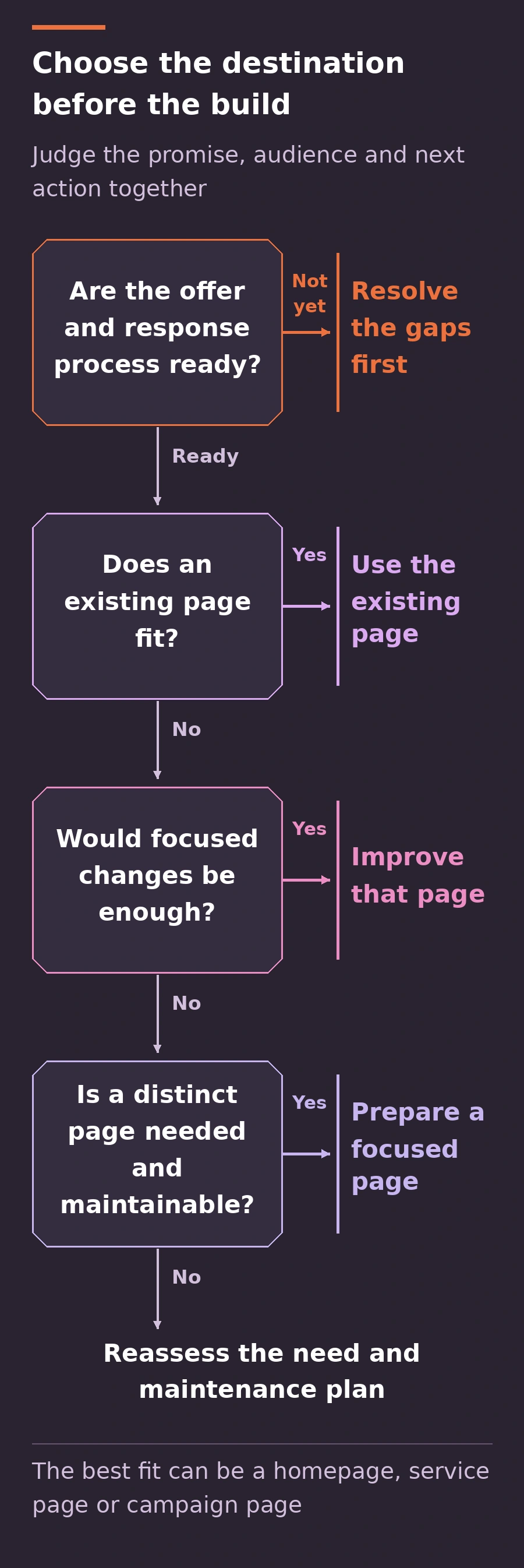
Check the pages you already have before commissioning another
A useful existing page may need a clearer opening, better supporting information or a more appropriate contact route. A separate page becomes worth considering when the campaign needs a substantially different explanation, audience emphasis or action that the current page cannot accommodate well
Use this comparison to record the reason for your choice. On a small screen, scroll horizontally to read all three columns
| Possible destination | When to consider it | What must be clear |
|---|---|---|
| Homepage | The campaign introduces the business or helps a broad audience explore its offer | The advertised subject is visible and relevant routes are easy to find |
| Existing service or product page | The current page already answers the specific need, or can do so with a focused improvement | Scope, suitability, supporting information and the next action match the campaign |
| Dedicated campaign page | The offer, audience or action needs a distinct explanation and the business can maintain it | The page fulfils the promise and connects to the right operational next step |
| Resolve the gap before launch | The offer, required information, contact route or ability to handle the response is not ready | A named person fixes the gap and checks it before traffic is sent |
Do not create a new page solely because a campaign is paid. Equally, do not force every specific offer into the homepage to avoid making a useful page. If the underlying question is which content belongs on a service page, our service-page and article guide covers that separate decision
Compare the same offer through different routes
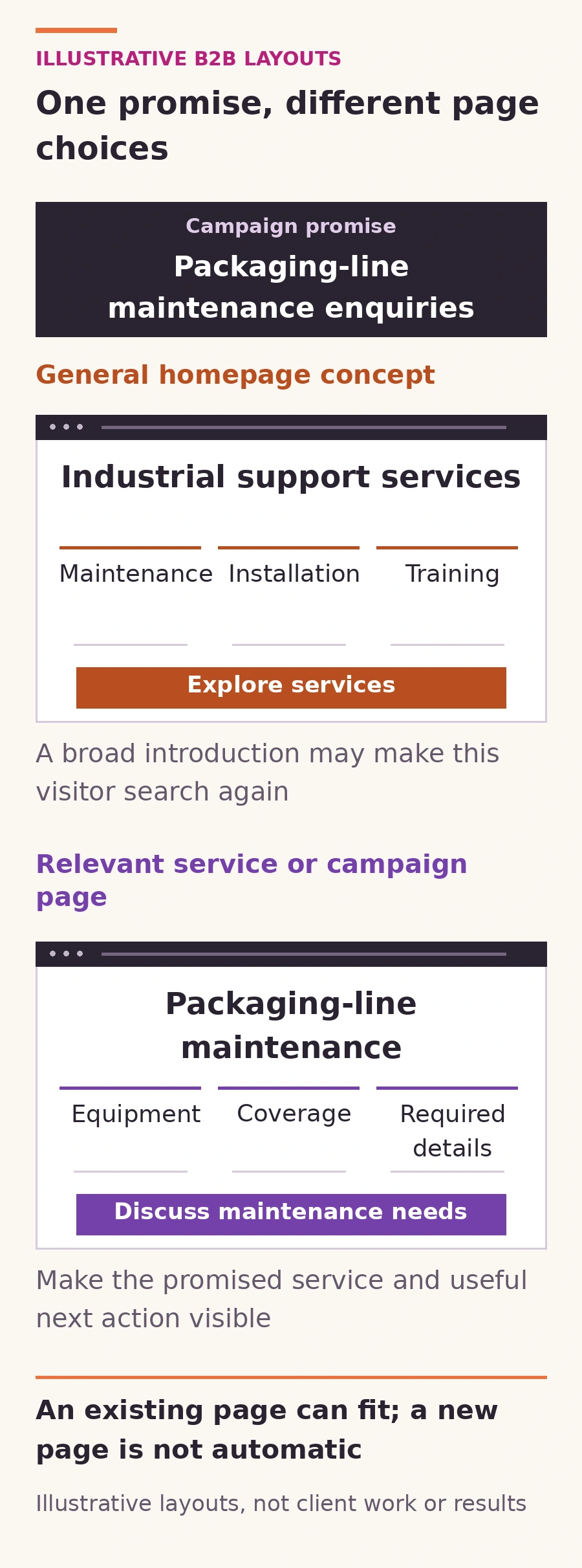
These hypothetical examples illustrate page choices, not ADAMS client work or measured results
An industrial maintenance enquiry
Imagine a business advertising maintenance for packaging lines. Its homepage introduces maintenance, installation and training. That may suit a general company introduction, but the maintenance visitor still needs to find which equipment and locations the service covers and what information to provide
A relevant existing maintenance page could answer those questions and invite the visitor to discuss the requirement. If it already serves that purpose, use it and make only necessary improvements. A dedicated campaign page is another option if the campaign has a distinct scope that needs its own explanation
Keep the promise consistent across the route. “Discuss maintenance needs” should lead to an enquiry process; it should not imply that an engineer visit is booked or a repair is confirmed merely because someone sends a message
A hotel meeting-space enquiry
Now imagine a hotel promoting meeting space to company event organisers. A general homepage may prioritise rooms and leisure facilities. A suitable meetings page can instead explain the spaces, equipment, access arrangements and information needed to check availability
If the existing meetings page already does that, it may be the appropriate destination. A separate campaign page could be useful for a distinct event offer, provided its terms and availability stay accurate. The action must distinguish requesting availability from receiving a confirmed reservation
Keep the page focused without removing useful reassurance
Choose a clear primary action and make supporting content help people decide whether to take it. Relevant service details, genuine authorised evidence, business identity and clear contact information can support that decision. Unrelated promotions do not need equal prominence
Focus does not require deleting every navigation link. People may need to check the business, find a related specification or understand a condition before enquiring. Google’s explanation of landing-page navigation emphasises relevant content and useful ways to reach the information people expected
Make the main action and any useful alternatives understandable on a phone and with a keyboard. Give form fields meaningful labels and explain what happens after submission. W3C’s form guidance explains why controls need labels that identify their purpose; a minimalist appearance alone does not establish accessibility
Check the complete route before sending traffic
Review the actual destination, not only a design preview. Assign the necessary corrections and verify them before launch
- Promise and scope: the advertised subject, limitations and next action remain consistent from message to page
- Language: the visitor reaches the intended language, with equivalent essential information and a useful language switch
- Mobile use: content, navigation and contact controls work without obstructive overlays or difficult horizontal scrolling
- Contact route: a clearly labelled test enquiry reaches the right recipient, and the confirmation describes what actually happened
- Response ownership: someone can answer the questions the campaign invites and keep time-sensitive information current
- Measurement: the team knows which interactions are recorded and how received enquiries will be checked
For Google Ads, the destination requirements also cover whether the destination works, is accessible to the intended users and is easy to navigate. These practical checks are not a complete policy audit or a guarantee of ad approval
Review the outcome you defined, not the page label
Agree what you will examine before changing the destination: whether visitors can find the relevant information, whether the contact route works and whether the business receives suitable enquiries. Keep the audience, offer and campaign context visible when comparing periods or versions
A contact-link click is not proof of a received or qualified enquiry. Changing a page alongside targeting, creative or availability also makes the cause of a result harder to isolate. Our enquiry-journey diagnostic explains how to investigate the broader problem without assuming that a new page will solve it
Choose the smallest page change that fulfils the campaign
Record the promise, audience, chosen destination, required changes and person responsible for approval and upkeep. If an existing page can do the job well, use it. If a distinct page is justified, brief it around the missing explanation and the real next step
ADAMS can help connect the campaign brief with the appropriate website design work. Share the campaign message, intended audience, current page and desired action, then discuss the page your campaign needs