
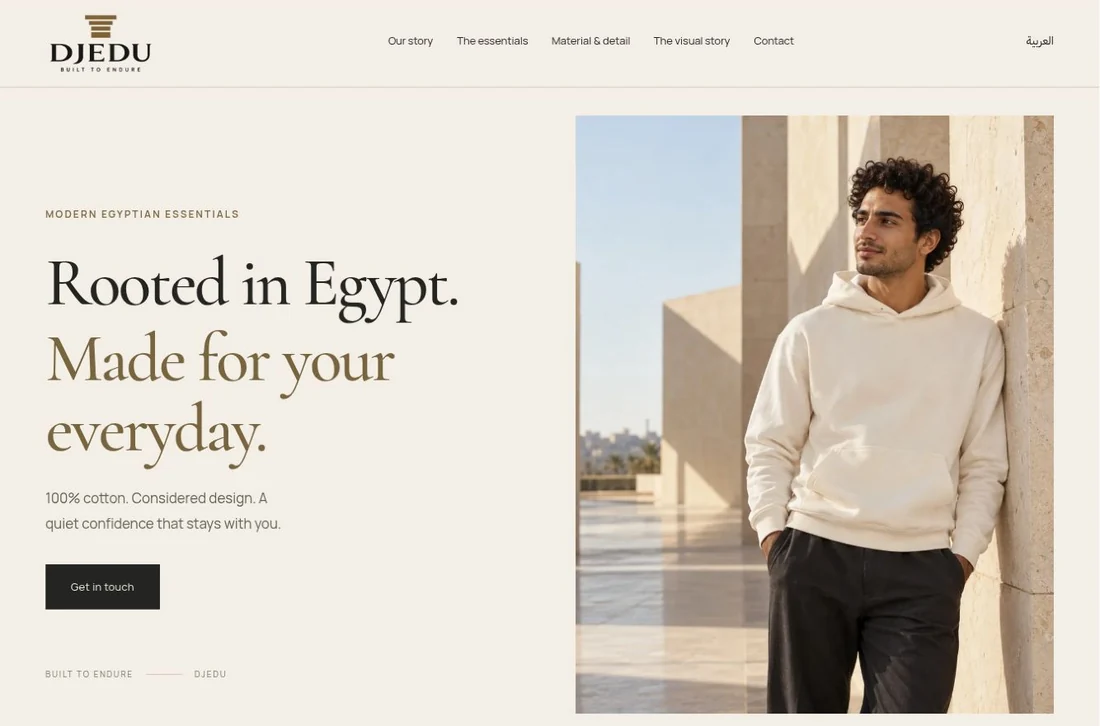
Actual ADAMS portfolio capture: the DJEDU website design. Its typography, message and photography can be examined as design choices; the image alone does not establish commercial results. This client project is separate from the fictional training-service studies below.
Two design proposals can look equally polished and still offer very different work. One may include exploring how to explain your service; another may assume that idea is already settled and concentrate on producing its applications. Counting the designs will not reveal that difference
When commissioning a defined creative project, compare the thinking you need, the evidence that makes a provider relevant and the decisions their process will help you make. Then examine the production scope. A proposal can be suitable without offering the largest collection of outputs
The training-service example and its design studies are illustrative, not client projects, competing agency submissions or evidence of business results
Give each proposal the same communication problem
Before comparing responses, agree what the design must help someone understand. “We need a more professional look” leaves the important question open. “An operations manager needs to understand what our service involves before getting in touch to discuss their needs” gives the proposed work a purpose you can examine
Provide the same approved audience, service information, existing identity and intended uses to each provider. Make clear which decisions are settled and which you are commissioning them to explore. Otherwise, one may quote for a new direction while another prices the application of your existing one
Keep this input brief and consistent. If the underlying task is still unclear, use our marketing brief guide first. This comparison starts once you can describe the problem, rather than asking each agency to solve a different one
The Design Business Association’s pitch guide recommends agreeing selection criteria in advance and looking for relevant capabilities and work. For your project, decide what matters before a striking portfolio image sets the terms of the discussion
Ask what an “idea” means in this proposal
An original design direction is a proposed way to communicate: what leads, how words and images work together, and why that approach suits the audience. A different colour or crop may be a useful variation within it. Neither the word “concept” nor a larger file count tells you how much exploration is included
Ask the provider to distinguish exploring possible directions, developing the selected direction and adapting it for agreed uses. These are our working definitions for comparing proposals, not universal units that every supplier uses identically. AIGA’s design-services agreement guide, page 8 also treats creative directions, refinements and final formats as separate matters to specify
A useful question is: “What decision will we be able to make after this stage, and what will you present to help us make it?” The answer may describe a rationale and examples from previous work; it does not require the agency to develop original designs for you before appointment
Adaptation has value when the direction is already approved. If you need to find the idea first, an execution-only proposal leaves that work unresolved. Compare the proposed work with your actual starting point
A worked example: different directions, different applications
Consider a fictional company introducing a sales-team training service on its website and social channels. Its shared communication problem is helping a manager understand whether the programme fits their team’s needs and what happens next. No training results or client claims are being proposed
Direction A: start with the team’s need
The explanation begins with situations the manager recognises, such as preparing a new sales team or improving how existing staff explain a service. The composition groups those needs and leads towards a discussion of the programme. The proposed rationale is to help the reader recognise a relevant starting point
Direction B: show how the training works
The explanation leads with the learning experience: a discussion, a practice exercise and feedback. A visual sequence makes the proposed service easier to picture. Its rationale is to address uncertainty about what participants would actually do. Any published description would still need the training company’s confirmation
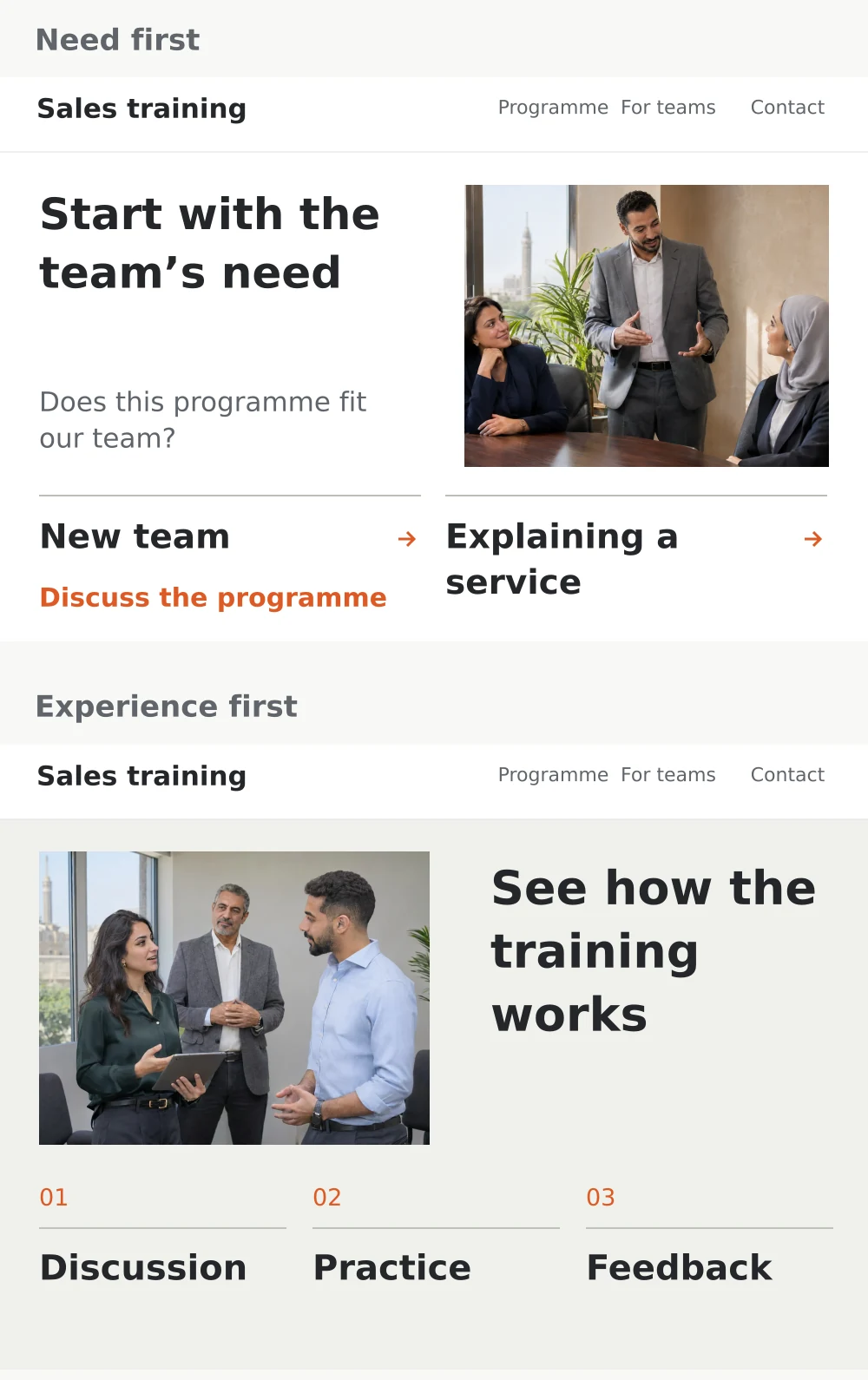
These are different communication approaches. A website section and a social image using Direction A are applications of that approach, even if their arrangement changes. They do not become additional original directions because they produce separate files
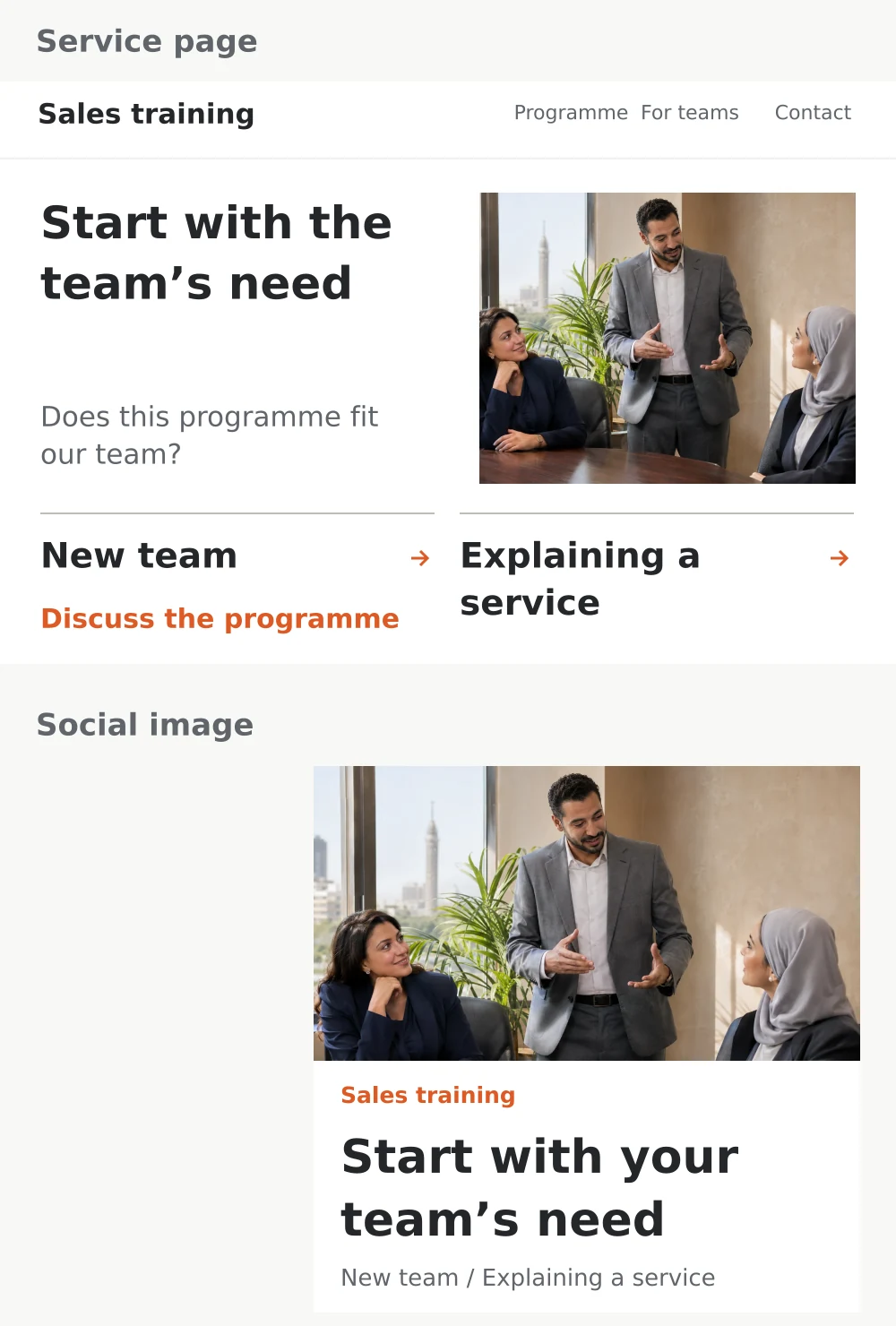
Now compare two fictional proposals. The first offers to explore a direction, explain its rationale and develop the selected approach. The second offers to apply an already approved direction to the required placements. Neither description alone makes one provider better. If the idea is unresolved, ask the second provider whether exploration is included; if it is settled, ask the first whether further exploration is needed
There is no declared winner in this example. The immediate decision is whether the proposals answer the same commission. Request a clarified response before treating unlike work as interchangeable
Read the reasoning behind the visual treatment
Ask how the proposed method connects your communication problem to the eventual design decisions. “Modern and premium” names an intended impression; it does not explain which information will lead, what material is needed or how the audience will understand the service
Look for a specific line of reasoning: the reader’s uncertainty, the proposed way to explain it, the material available to support that explanation, and the application in which it needs to work. A relevant question might be: “How would you decide whether a process illustration or a photograph explains this service better?”
Research needs the same clarity. Reviewing existing materials and competitors differs from conducting customer interviews or formal market research. The DBA’s proposal guide distinguishes those activities. Ask what the stated research will examine and what it will contribute to the design decision
Reasoning makes an approach discussable; it does not prove that it will increase enquiries. Any performance claim needs its own appropriate evidence, rather than an attractive presentation or confident explanation
Use the portfolio to investigate relevant evidence
Choose an existing project that resembles the challenge, not simply your preferred visual style. Ask what the original problem was, what the provider actually contributed and why the approach was chosen. Where several organisations worked on it, clarify the role behind the displayed work
Separate what you can see from what needs confirmation. You can examine a supplied layout’s hierarchy and the relationship between its message and imagery. You cannot establish who developed the idea, whether it went live or what caused a reported business outcome from the image alone
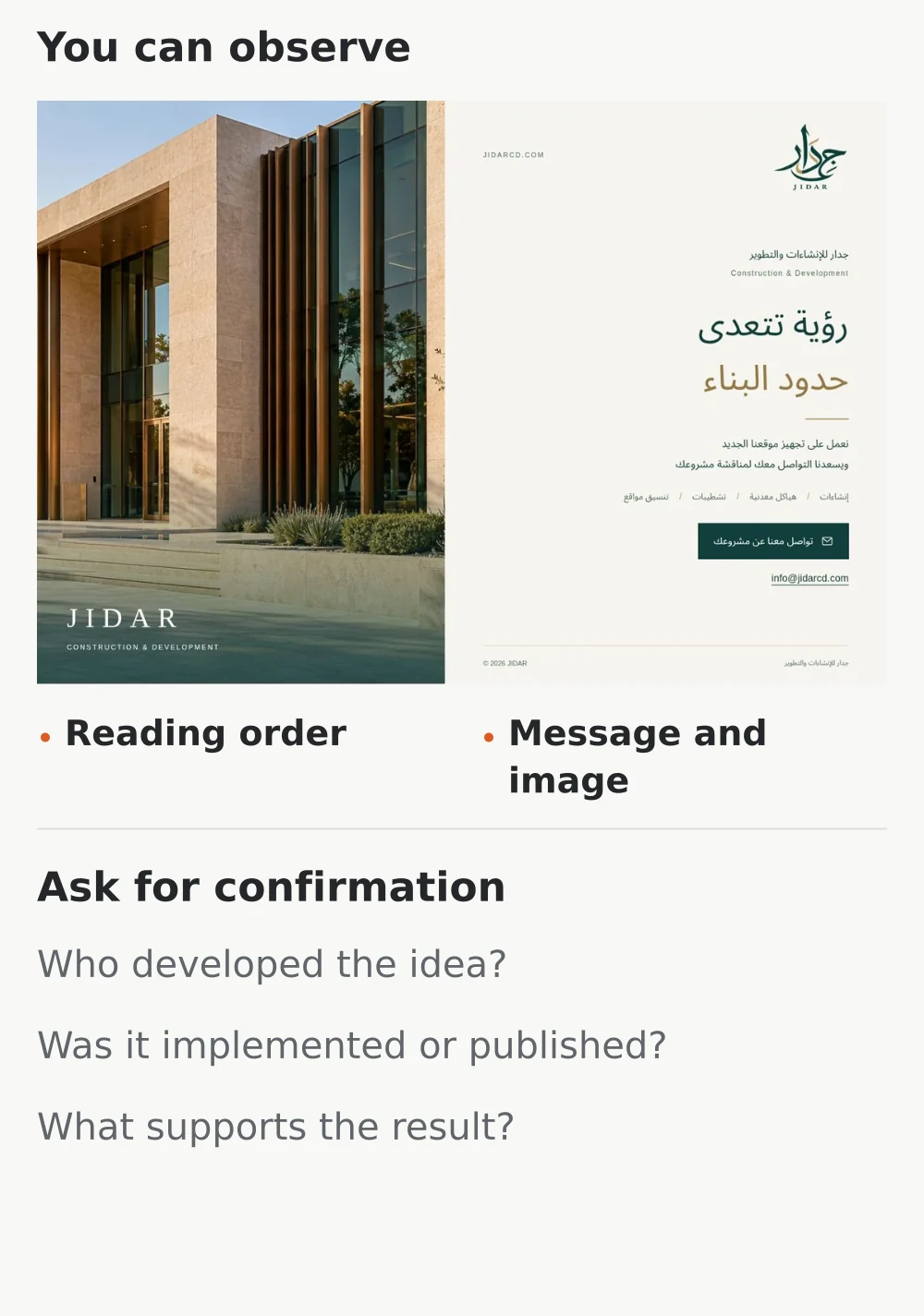
If Arabic is part of your commission, request a relevant existing Arabic example and discuss who writes and reviews it. If the work must function on a website, clarify whether the example is an illustration, a design mockup or a working implementation. Evidence relevant to the task is more useful than a presentation assembled entirely from unrelated applications
You can conduct this discussion without asking competing agencies for unpaid original concepts. The DBA’s advice for design buyers recommends assessing relevant credentials rather than speculative free creative. Where a new exploration is needed before the full project can be defined, agree its purpose, outputs and fee as a separate paid stage
Resolve the unknown that could change your choice
Record your assessment in plain language: what the proposal demonstrates, what it states but you have not confirmed, and what remains unanswered. Avoid turning an unanswered question into a low score for capability; ask for the relevant evidence first
Concentrate the follow-up on matters that affect selection. Does the team develop the message or require approved copy? Can it show relevant Arabic work? Who develops the proposed direction? Does “website design” mean a mockup or implementation? Will the selected approach be demonstrated in the use that matters most to your project?
Clarify what you will review and approve, and the required handover, before appointment, including the agreed editable files and any asset-use conditions. These details matter, but they should not replace the discussion of the creative task. For a continuing social engagement, our social-media retainer scope guide covers the separate production and responsibility questions
Choose when you can explain why a provider’s relevant work, proposed method and clarified response fit the commission, with the cost and remaining conditions understood. If an important uncertainty remains, seek clarification rather than letting presentation polish decide it
For an upcoming design project, explore ADAMS Creative Design with your communication problem, existing materials and intended uses. We can clarify whether the work needs a new direction, development of an existing idea or its application across agreed digital placements, so the proposal describes the work you actually need